Feb 12, 2026
EPIRBs, PLBs and Maritime Emergency Signalling Devices
Russell Lake


A Guide to Life-Saving Technology
Emergency signalling devices are critical tools designed to save lives in remote areas, whether on land, sea, or air. Among the most widely recognised devices are Emergency Position Indicating Radio Beacons (EPIRBs) and Personal Locator Beacons (PLBs). These devices are employed to send distress signals in emergency situations, ensuring that rescue teams can locate individuals quickly and efficiently. Whether you're preparing for your RYA Day Skipper Theory course or planning extended offshore passages, understanding these life-saving devices is essential. This document delves into their functionalities, differences, applications, and importance in various scenarios.
About the Author
Russell Lake is an RYA Principal and founder of Sailing Course Online, based at Hamble Point Marina on the Solent. He sits on the RYA Training Committee and the British Marine Access to Boating Committee. Russell has trained personnel for the RYA and Maritime & Coastguard Agency, supported Clipper Round the World Race participants, and established Egypt's first RYA Training Centre. His offshore experience includes three RORC Fastnet campaigns as skipper and a circumnavigation of Britain by RIB. Over 50,000 students from 115 countries have completed courses through Sailing Course Online.
Learn more about our instructors
What Are EPIRBs?
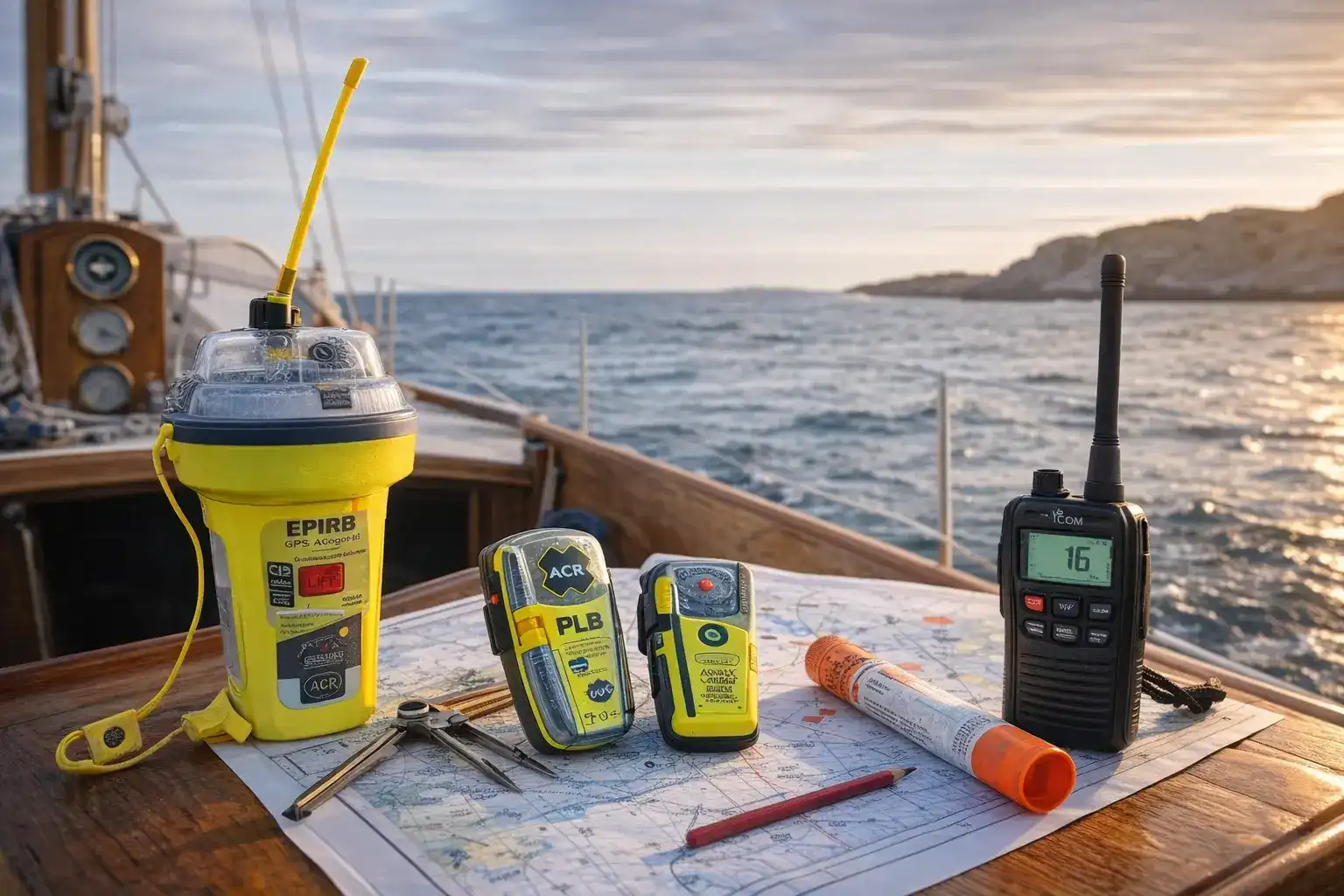
EPIRBs, short for Emergency Position Indicating Radio Beacons, are devices specifically designed for maritime emergencies. They are mandatory on many vessels and serve as a critical tool for seafarers and adventurers navigating the oceans.
How EPIRBs Work
EPIRBs operate by transmitting distress signals to satellites, which are then relayed to ground stations and rescue coordination centres. These signals include the beacon's unique identification number and often its GPS coordinates, allowing rescuers to pinpoint the location of the distressed vessel or individual. EPIRBs use the COSPAS-SARSAT satellite system, a globally recognised network for emergency response.
Types of EPIRBs
EPIRBs come in two main types:
Category I: These are automatically activated when submerged in water. They are typically stored in a free-floating bracket and are designed to deploy in case of sinking.
Category II: These require manual activation and are commonly used on smaller vessels or as supplementary safety devices.
Applications
EPIRBs are essential for commercial vessels, as required by international maritime regulations, recreational sailors and yachtsmen for added security during voyages, and fishing boats and offshore workers operating in hazardous waters.
What Are PLBs?
Personal Locator Beacons (PLBs) are versatile emergency devices suitable for use in various environments, including land and water. Unlike EPIRBs, PLBs are not restricted to maritime applications, making them ideal for hikers, campers, climbers, and other outdoor enthusiasts.
How PLBs Work
PLBs also utilise the COSPAS-SARSAT satellite system and function similarly to EPIRBs. Once activated, they send out distress signals containing unique identifiers and, in most cases, GPS data. The compact size of PLBs makes them highly portable and convenient for personal use.
Key Features of PLBs
Compact Design: Designed to be carried easily, PLBs are lightweight and simple to operate.
Manual Activation: Activation requires manual intervention, ensuring that the device is used intentionally.
Durability: Built to withstand harsh environmental conditions including water exposure, extreme temperatures, and physical impact.
Applications
PLBs are widely used by outdoor adventurers exploring remote locations, sailors at risk of falling into the sea, solo travellers or trekkers in high-risk areas, and workers in isolated environments such as forestry or mining operations.
Differences Between EPIRBs and PLBs
While EPIRBs and PLBs share the common purpose of sending distress signals, their differences stem from their intended usage and design:
Primary Use: EPIRBs are designed for maritime use, while PLBs are more versatile and can be used on land or water.
Activation: EPIRBs can be automatically activated (Category I), whereas PLBs are always manually activated.
Size: PLBs are smaller and lighter, making them easier to carry, compared to the bulkier EPIRBs.
Battery Life: EPIRBs typically have longer battery life than PLBs, as they are built for prolonged emergencies at sea.
Registration and Activation of Emergency Beacons
Registering your EPIRB or PLB is not optional, it's a critical step that can save precious time during a rescue. When you activate an emergency beacon, the COSPAS-SARSAT system transmits your unique hexadecimal identification code to rescue coordination centres. Without registration, authorities receive a distress signal but have no information about who needs help, what vessel is involved, or who to contact.
How to Register Your Beacon in the UK
In the UK, register your EPIRB or PLB with the national beacon registration database managed by the Maritime and Coastguard Agency (MCA). The registration process is free and can be completed online. You'll need to provide your beacon's unique 15-character hexadecimal ID (printed on the device), vessel details including name, type, size, and registration number (for EPIRBs), personal details and emergency contact information, and details of your typical operating area.
Update your registration whenever you change vessels, sell your boat, or modify emergency contacts. Many false alarms occur when rescue teams respond to beacons with outdated registration information.
When and How to Activate
Only activate your emergency beacon when you face grave and imminent danger and require immediate assistance. False activations waste critical rescue resources and may delay response to genuine emergencies.
For manual activation: Remove the beacon from its mounting bracket or storage, deploy the antenna fully, ensure clear sky view for satellite communication, press and hold the activation button as instructed, and keep the beacon on until rescue arrives or you're told to deactivate.
For automatic Category I EPIRBs: The hydrostatic release unit will automatically deploy and activate the beacon when submerged at depths of 1.5–4 metres. This ensures activation even if you're unable to manually trigger the device.
If you accidentally activate a beacon, contact the Coastguard immediately on VHF Channel 16 or by telephone. Provide your beacon's hex ID and confirm it's a false alarm. This simple action prevents unnecessary search and rescue operations.
Understanding the COSPAS-SARSAT Satellite System
The COSPAS-SARSAT system is the international satellite network that makes EPIRB and PLB distress signals effective worldwide. Understanding how this system works helps you appreciate why these devices are so reliable.
The Three Satellite Systems
LEOSAR (Low Earth Orbit Search and Rescue): These satellites orbit at approximately 850 km altitude, passing over any point on Earth several times per day. When an EPIRB or PLB activates, LEOSAR satellites detect the 406 MHz signal and use Doppler shift calculations to determine your location, even without GPS. Position accuracy ranges from 2–5 km. Processing time varies from 90 minutes to 5 hours depending on satellite position.
GEOSAR (Geosynchronous Search and Rescue): Positioned at 36,000 km altitude over the equator, these satellites provide near-instantaneous alert capability for vessels equipped with GPS-enabled beacons. GEOSAR cannot calculate position independently but immediately relays your GPS coordinates to rescue coordination centres. Coverage extends from approximately 70°N to 70°S latitude.
MEOSAR (Medium Earth Orbit Search and Rescue): The newest component of COSPAS-SARSAT, MEOSAR satellites orbit at 20,000–24,000 km altitude. They provide near real-time detection (typically within 5 minutes) and precise location data. MEOSAR also enables Return Link Service (RLS), sending a confirmation message back to your beacon that your distress signal has been received.
How Your Distress Signal Reaches Rescue Teams
When you activate an emergency beacon, the beacon transmits a 406 MHz signal containing your unique ID and GPS position (if equipped). Satellites detect the signal and relay it to ground stations called Local User Terminals (LUTs). LUTs process the data and forward it to Mission Control Centres (MCCs). Your national MCC identifies your beacon registration and alerts the appropriate Rescue Coordination Centre (RCC). The RCC dispatches search and rescue assets to your location.
This entire process can occur in as little as 5 minutes with MEOSAR satellites, or up to 5 hours with LEOSAR satellites depending on orbital positions.
Learn more about the COSPAS-SARSAT system
Choosing the Right Emergency Beacon for Your Sailing
The best emergency signalling device depends on your vessel type, sailing area, and crew requirements. Here's how to make the right choice:
Coastal and Inshore Sailing (up to 20 miles offshore)
Minimum Recommendation: Category II EPIRB (manual activation), VHF radio with DSC capability, and pyrotechnic flares (red hand flares and orange smoke).
Enhanced Safety: Add PLBs for each crew member working on deck and ensure EPIRB mounting location is easily accessible.
Offshore Passages (20–150 miles)
Minimum Recommendation: Category I EPIRB (automatic activation with float-free bracket), PLBs for crew members on watch, VHF radio with DSC, full complement of pyrotechnic flares, and satellite messenger for two-way communication.
Ocean Voyaging and Extended Offshore
Recommended Equipment: Category I EPIRB with GPS (mandatory), PLB for every crew member, satellite communication system (phone or messenger), complete pyrotechnic flare set including parachute rockets, radar reflector and AIS transponder, and SART (Search and Rescue Transponder).
Special Considerations
Singlehanded Sailing: Personal PLBs become critical. If you fall overboard, the vessel's EPIRB won't help. Consider a PLB integrated into your lifejacket that activates automatically upon immersion.
Family Cruising: Ensure sufficient PLBs for all family members. Modern PLBs are small enough for children to carry safely in lifejacket pockets.
Budget Constraints: If cost is a concern, prioritise a properly registered Category II EPIRB over a Category I. Manual activation is better than no EPIRB at all. Add PLBs progressively as budget allows.
UK Regulations and SOLAS Requirements
Understanding regulatory requirements ensures compliance and proper insurance coverage.
Commercial Vessels
Under SOLAS (Safety of Life at Sea) regulations, commercial vessels must carry at least one EPIRB capable of float-free automatic activation. The EPIRB must transmit on 406 MHz (121.5 MHz beacons are no longer acceptable). Annual servicing and battery replacement must be completed as per manufacturer specifications, and valid registration with the national authority is required. The Maritime and Coastguard Agency (MCA) enforces these requirements for UK-flagged vessels.
Recreational Craft
UK pleasure vessels have no legal requirement to carry EPIRBs. However, many insurance companies require EPIRBs for offshore passages or specific sailing areas, charter companies typically mandate EPIRBs and often PLBs, some harbourmasters require EPIRB carriage for vessels making extended passages, and offshore racing regulations (RYA, RORC, etc.) specify Category I EPIRBs for qualifying events.
Insurance Implications
Most marine insurance policies strongly recommend or require emergency signalling equipment for offshore passages. Failure to carry required safety equipment may invalidate claims in the event of an incident. Check your specific policy requirements with your insurer.
Other Emergency Signalling Devices
Beyond EPIRBs and PLBs, there are other devices that also serve similar purposes:
Satellite Messengers
Satellite messengers allow users to send text messages and GPS coordinates to designated contacts or emergency services. They are popular among adventurers requiring two-way communications.
Rescue Flares
Rescue flares are visual signalling tools used to attract attention during emergencies. They are considered supplementary devices to EPIRBs and PLBs.
Two-Way Radios
Radios can provide communication with nearby vessels or rescue teams. While they lack the global reach of satellite-based devices, they remain effective for short-range distress calls.
Importance of Emergency Signalling Devices
Emergency signalling devices are vital for ensuring safety and survival during critical situations. They provide a lifeline for individuals stranded in remote areas, offering reassurance and increasing the likelihood of timely rescue. Their importance extends beyond just peace of mind; they are often lifesaving tools in situations where every second counts.
Conclusion
EPIRBs, PLBs, and other emergency signalling devices have revolutionised the way distress calls are managed, significantly improving rescue operations worldwide. Whether you're navigating the high seas or trekking through uncharted wilderness, these devices should be an essential part of your safety toolkit.
Invest wisely in the right device for your needs—whether that's preparing for your RYA Coastal Skipper/Yachtmaster™ Theory qualification or planning offshore adventures. Proper registration, regular maintenance, and understanding when and how to activate your emergency beacon could make the difference between life and death in an emergency situation. The COSPAS-SARSAT satellite network stands ready 24/7 to relay your distress signal to rescue teams, but only if your equipment is properly maintained and registered.