Oct 16, 2026
Essential Navigation and Seamanship or the Day Skipper Shorebased Course: Which Should You Take?
Last updated: October 2026
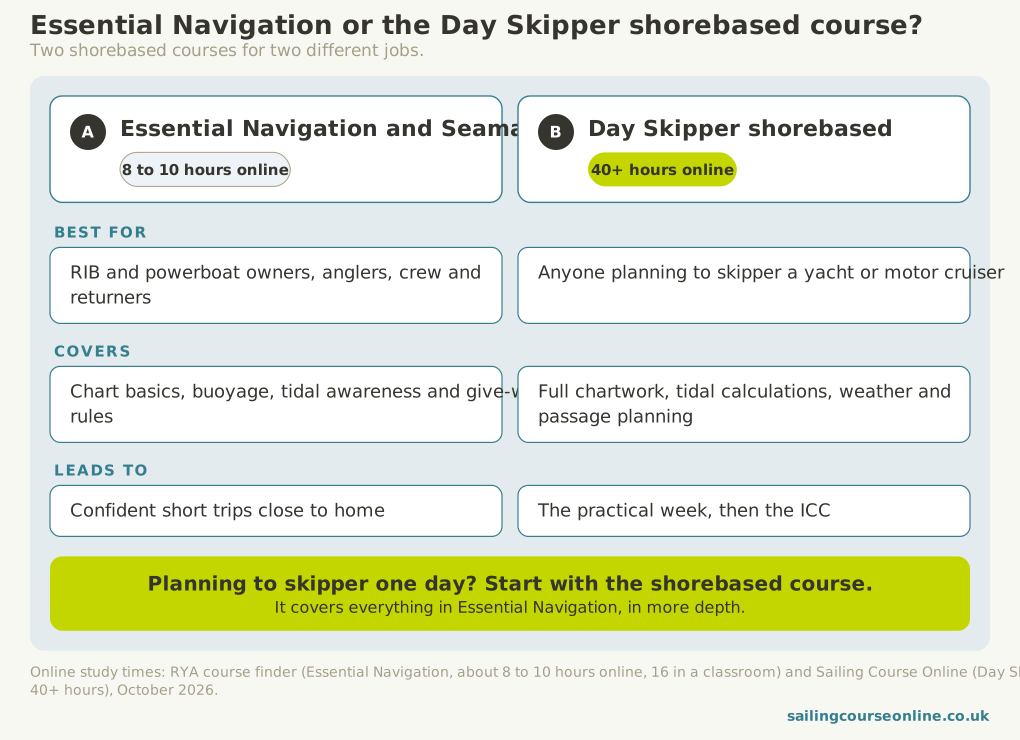
If you want to read a chart, understand buoyage and plan a safe trip close to home, take RYA Essential Navigation and Seamanship. It is a short introduction of about 8 to 10 hours online. If you want to skipper a yacht or motor cruiser, go on to the Day Skipper practical or get an International Certificate of Competence (ICC) to charter abroad, take the RYA Day Skipper shorebased course. Our online Day Skipper theory course runs to 40 hours or more, finishes with two exam papers, and is the knowledge half of the Day Skipper qualification.
- Choose Essential Navigation if you run a RIB or small powerboat, fish or dive from a boat, crew for friends, or are coming back to boating after years away and want the basics in an evening or two.
- Choose the shorebased course if you plan to be the skipper: chartering, taking a yacht or motor cruiser out with family, or working towards the practical week.
- If you are unsure but think you will skipper one day, go straight to the shorebased course. It covers everything in Essential Navigation, in more depth.
About the Author
Richard Beniston is an RYA Yachtmaster™ Examiner for Sail and Power, and one of only 22 RYA Instructor Trainers worldwide. He has 23 years' experience in professional sailing instruction, including three RORC Fastnet campaigns as skipper, Atlantic crossings, and sail training on tall ships in the Baltic. He is Chief Instructor at Sailing Course Online, an RYA-approved online theory provider based at Hamble Point Marina, which delivers RYA Day Skipper and Coastal Skipper/Yachtmaster™ Offshore theory courses to students in over 115 countries.
Learn more about our instructors
Essential Navigation vs the Day Skipper shorebased course at a glance
The hours quoted for Essential Navigation range from 6 to 16 depending on where you look. That is because the classroom version is taught over 16 hours, while the online version takes most people about 8 to 10 hours, according to the RYA's course finder (October 2026).
| Essential Navigation and Seamanship | Day Skipper shorebased | |
|---|---|---|
| Who it suits | New boaters, RIB and powerboat owners, anglers, divers, crew, returners | Anyone planning to skipper a yacht or motor cruiser |
| Study time online | About 8 to 10 hours | 40+ hours |
| Study time in a classroom | 16 hours | Usually 5 days or 10 evenings |
| Experience needed | None | None |
| Depth | Chart basics, tidal awareness, buoyage, give-way rules | Full chartwork, tidal height and stream calculations, weather, pilotage, passage planning |
| Assessment | Exercises through each module | Two 120-minute papers, sat online at home or in your classroom |
| Leads to | Confident short trips; the next level shorebased course if you want more | The Day Skipper practical, then the ICC |
| Counts towards an ICC | No | Not on its own; the practical certificate is what counts |
What does Essential Navigation and Seamanship cover, and who is it for?
Essential Navigation and Seamanship is a short theory course that teaches the navigation and safety knowledge you need before taking a small boat out in familiar waters. The RYA describes it as "an introduction to navigation and safety awareness" for sailors, powerboaters, sea anglers, divers and boatmasters.
It covers 11 topics:
- charts, publications and terms
- buoyage
- basic navigation: plotting a position, measuring distance and bearing
- safety equipment and procedures
- anchoring
- tidal streams and heights, at an awareness level
- electronic navigation and waypoints
- the rules of the road
- weather forecasts
- pilotage
- passage planning
What you can do afterwards
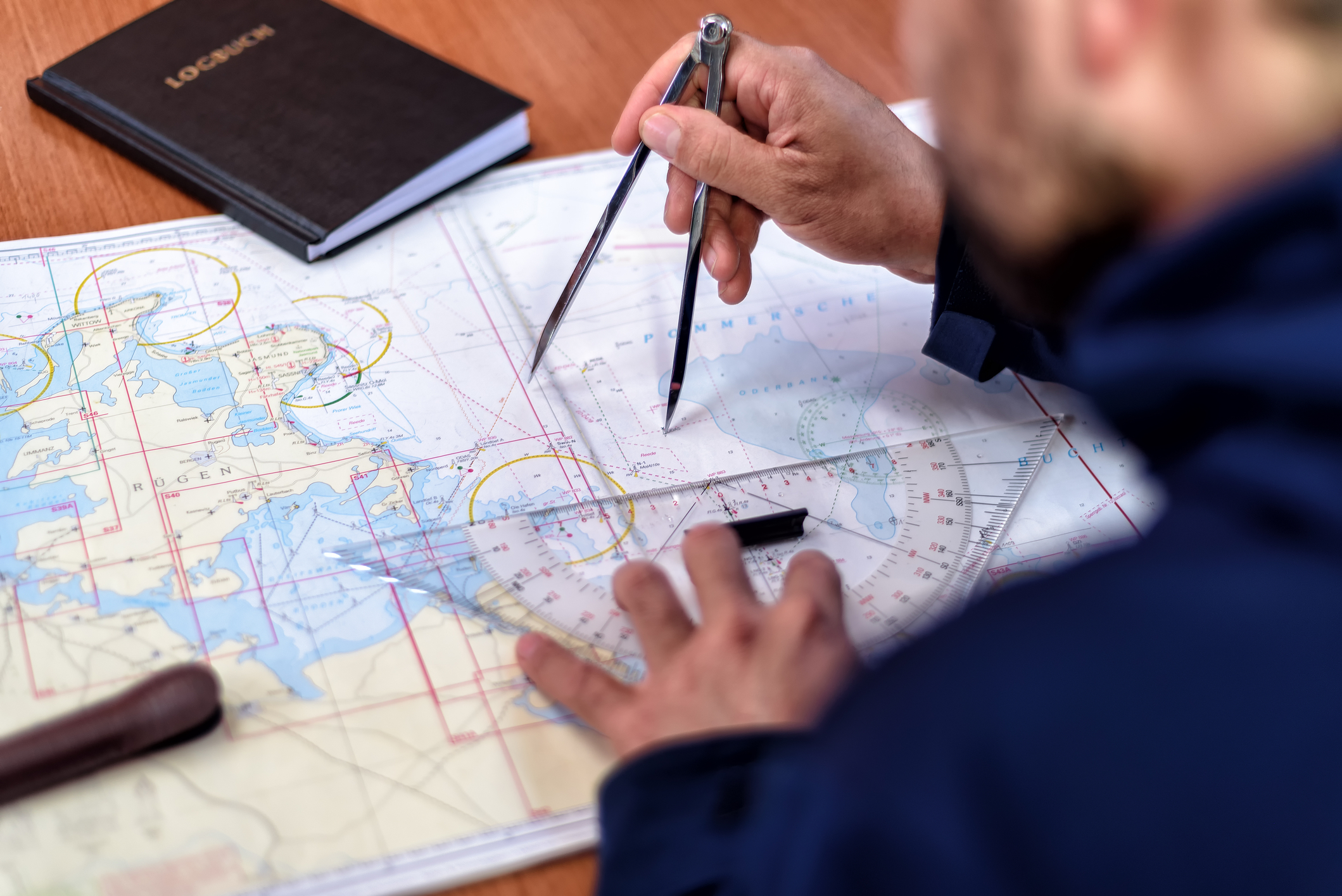
By the end you should be able to read a chart, recognise the buoys around you, work out who gives way, and put together a simple plan for a short coastal trip. There is no minimum age and no experience needed, and you can check the full syllabus on the RYA course finder. Our online version comes with a plotter, dividers, training charts and the handbook, which you can see in the Essential Navigation course pack.
What does the Day Skipper shorebased course cover, and where does it lead?
The Day Skipper shorebased course is all the theory behind skippering a small yacht or motor cruiser in familiar waters by day. It is the precursor to Coastal Skipper and Yachtmaster™.
It goes much further than Essential Navigation in the topics that decide whether you can plan a passage on your own:
- chartwork, including fixes, estimated positions and course to steer
- tidal heights and tidal streams, worked out from the almanac
- meteorology and reading a forecast for a passage
- the collision regulations in full, including lights, shapes and sound signals
- pilotage into unfamiliar harbours
- electronic navigation and digital passage planning
At Sailing Course Online the course runs to 40+ hours of study (October 2026). It finishes with two 120-minute papers: a general paper, and a chartwork paper using the almanac and training charts. Both are sat online from home. Here is what the two shorebased exam papers involve. Our version also includes bespoke exercises built around the savvy navvy navigation app!
The shorebased course in numbers
- 40+ hours of study, at your own pace
- 2 exam papers, 120 minutes each, sat online from home
- No experience needed to start
- 5 days on the practical afterwards to complete the Day Skipper qualification
On its own, the shorebased certificate does not let you charter. Combine it with the five-day practical and you hold the Day Skipper qualification, which is the usual route to the ICC. Here is how the ICC works for sailors, and the syllabus is set out on the RYA course finder.
Do you need Essential Navigation before the Day Skipper shorebased course?
No. The Day Skipper shorebased course needs no previous experience, and it teaches every Essential Navigation topic again from the beginning, in more depth. If you already know you want to skipper, doing both means covering the opening chapters twice.
Doing Essential Navigation first still makes sense in a few situations:
- You are not yet sure boating is for you and want a short, low-commitment start.
- You plan a season on the water as crew before deciding whether to skipper.
- You are returning after years away and want to check what you remember before committing to 40 hours.
If any of those fit, the time is not wasted. The chart and buoyage basics will feel familiar when you reach the Day Skipper shorebased course, so the early modules go faster.
How hard is the shorebased course for a complete beginner?
The Day Skipper shorebased course is designed for beginners, and most people with no experience pass it. The part that takes real effort is the chartwork: plotting positions, working out tidal heights and calculating a course to steer across a tidal stream. These are methods with several steps, and they take practice before they click.
Three things make it manageable when you study online:
- Your own pace. You can repeat a chartwork exercise as many times as you need before moving on, which a classroom cannot offer.
- Tests as you go. Each topic ends with a marked test, so you know you are ready before the exam.
- Resits. If a paper does not go to plan, you can sit it again.
Most of our students spread the 40 hours over four to eight weeks, doing an hour or two at a time. If the idea of tidal calculations puts you off before you have started, that is a fair reason to begin with Essential Navigation and move up once the basics feel familiar.
I have Powerboat Level 2. Is Essential Navigation enough?
For most RIB and powerboat owners, yes. Powerboat Level 2 is the certificate that counts towards an ICC for a powerboat, so you do not need a theory qualification to get one. Here is more on getting an ICC with Powerboat Level 2.
What Powerboat Level 2 does not give you is much navigation. Essential Navigation fills that gap. It teaches you to read the chart, allow for the tide, recognise the marks and plan a trip along the coast, which is what you need once you go beyond the harbour you know.
Move up to the Day Skipper shorebased course instead if you are buying a larger motor cruiser, planning longer passages, or want to take the motor version of the Day Skipper practical. Before you go, it is worth checking whether you need a licence to drive a boat in the waters you plan to use.
How we help students choose
When students ask us which course to start with, we ask where they want to be in two years' time. Three questions usually settle it:
- Do you want to be the person in charge of the boat? If yes, the shorebased course is the one that gets you there.
- Are you planning to charter, or to take the practical week? Both need the Day Skipper route, so Essential Navigation would only add a step.
- Is the goal using your own small boat more confidently, close to home? Then the shorter course usually does the job, and you can move up later.
The mistake we see most often is choosing the shorter course to save time, then booking the full course six months later anyway.
If you can picture yourself as the skipper, start with the course that gets you there. You can see how the two courses sit within the full RYA qualifications ladder.
Frequently asked questions
What does each course cost?
At Sailing Course Online, Essential Navigation and Seamanship is £120 and the Day Skipper shorebased course is £260. Both prices include the training pack and postage (October 2026).
Can I do either course for free?
No. Both are approved courses with a course pack and instructor support, so neither is free. You can read the syllabus for each on the RYA's course finder before you decide.
Does Essential Navigation give me a qualification I can show a charter company?
No. Charter companies look for Day Skipper or an ICC. Essential Navigation is for your own knowledge and safety rather than for proving competence to a third party.
If I do Essential Navigation first, can I move on to the Day Skipper shorebased course later?
Yes, at any time. Nothing carries over formally, but the chart, buoyage and rules-of-the-road basics will already be familiar, so the first modules of the shorebased course go faster.
Ready to choose?
Both courses start as soon as you enrol, with the training pack posted out to you and an instructor on hand by email, phone or video call while you study.
- Want the basics for short trips close to home? See what is included in the Essential Navigation course.
- Planning to skipper, charter or take the practical? Start the Day Skipper shorebased course.