Port is the left-hand side of a boat and starboard is the right-hand side, when you are on board and facing the bow. The words never change. Left and right depend on which way a person happens to be facing, so a crew member facing aft has their left and right reversed relative to the helm. Port and starboard are fixed to the boat itself, which is why every instruction on board uses them.
Port is marked at night by a red light and starboard by a green one, and those colours run through the whole system: they appear on channel buoys, in the collision regulations, and in the language of who gives way when two vessels meet. Learn the sides and you have the first piece of your sailing dictionary.
This guide covers which side is which, why sailors use the words at all, how to remember them under pressure, the rest of the terms that go with them, and the three encounters at sea where port and starboard decide who alters course.
About the Author
Russell Lake is an RYA Principal and founder of Sailing Course Online, based at Hamble Point Marina on the Solent. He sits on the RYA Training Committee and the British Marine Access to Boating Committee. Russell has trained personnel for the RYA and Maritime & Coastguard Agency, supported Clipper Round the World Race participants, and established Egypt's first RYA Training Centre. His offshore experience includes three RORC Fastnet campaigns as skipper and a circumnavigation of Britain by RIB. Over 50,000 students from 115 countries have completed courses through Sailing Course Online.
Learn more about our instructors
Which side is port and which is starboard?
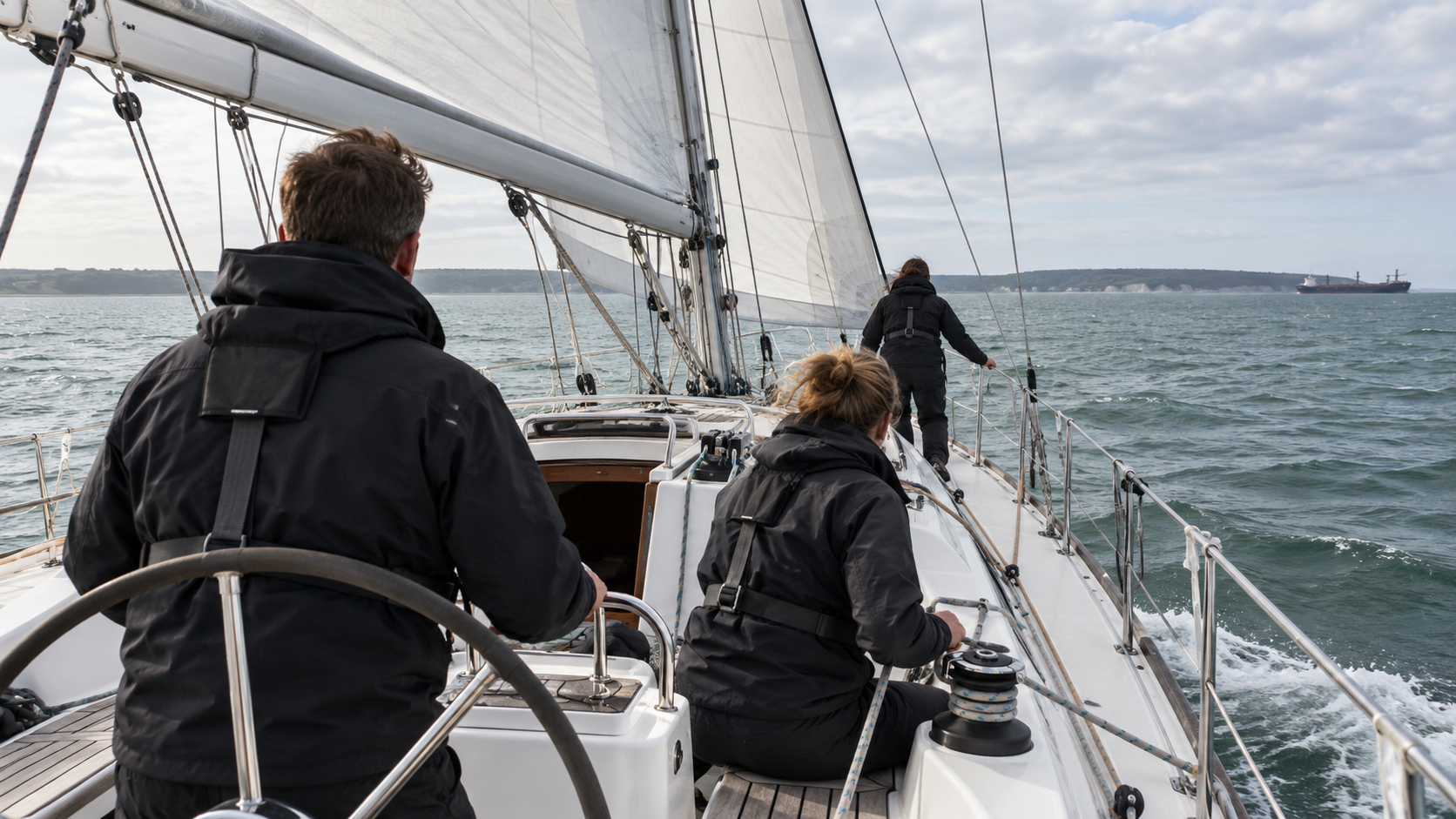
Facing the bow, port is on your left and starboard is on your right. The reference point is the boat, not the person, so the port side stays the port side whether you are standing at the bow looking forward, sitting in the cockpit looking aft, or below deck with no view at all.
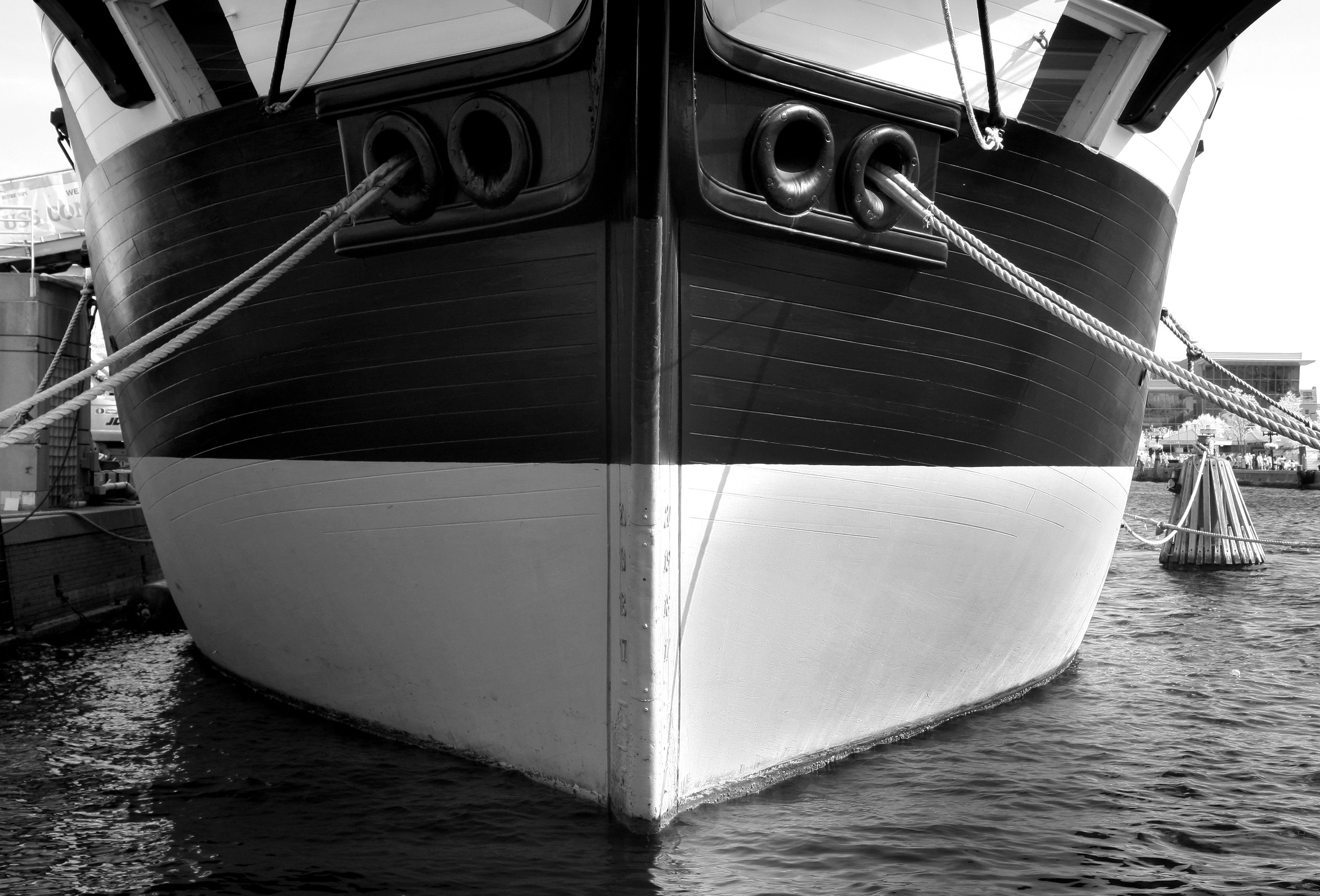
Two details catch people out. The first is that the terms describe sides of the vessel rather than directions of travel, so "the buoy is to port" means the buoy is off the left-hand side of the boat. The second is that a helm order is about where the bow goes: "port ten degrees" turns the bow to the left.
| Port | Starboard | |
|---|---|---|
| Side | Left when facing the bow | Right when facing the bow |
| Light at night | Red | Green |
| Lateral buoy (UK) | Red can, entering harbour | Green cone, entering harbour |
| Sailing tack | Wind on the port side | Wind on the starboard side |
| Memory aid | Port and left both have four letters | Starboard has two Rs, as in right |
Why do sailors use port and starboard instead of left and right?
Sailors use port and starboard because they cannot be misread, whatever the crew are doing or which way they are facing. On a boat people work in every orientation at once. Someone hauling a line at the mast may be facing aft while the helm faces forward, so an order to "fend off on the left" produces two different answers and a moment of hesitation nobody can afford when a hull is closing on a pontoon.
The fixed terms remove that ambiguity. As the NOAA National Ocean Service puts it, port and starboard refer to fixed locations on a vessel, unlike left and right. The same logic explains why they survive on aircraft and spacecraft, where crews also work facing in different directions.
There is a second reason, and it matters more at night. Because port and starboard are tied to red and green, they let one vessel describe another vessel's aspect without seeing her shape at all. A skipper who reports a green light fine on the starboard bow has told you which way that vessel is heading and which of you is likely to give way.
Where the words come from
Starboard comes from the Old English steorbord, meaning the steering side. Before the stern-hung rudder arrived in medieval Europe, boats were steered with an oar hung over one side, and because most people are right-handed that oar sat on the right.
A boat with a steering oar on the right cannot come alongside a quay on that side without damaging it, so she berthed with her left side to the harbour. That side was called larboard, from the Middle English ladebord, most likely the loading side.
Larboard and starboard sound almost identical shouted across a deck in bad weather, and the Royal Navy eventually acted on it. An Admiralty circular of 22 November 1844 abolished larboard and made port the standard term, on the grounds that the distinction between starboard and port is far more marked. The United States Navy followed in 1846. The word port was already in use for the harbour side, so the change formalised what many crews were saying anyway.
How to remember port and starboard
The reliable memory aids all work by tying the word to something with the same shape, length or colour. Most sailors end up using two or three together and pick whichever surfaces fastest under pressure.
Port and left both have four letters. The simplest of the lot, and the one that survives being tired and cold.
There is no red port left in the bottle. Red, port and left in one phrase. Port wine is red, so port is the red side, and red is on the left. This one is worth learning because it carries the light colour as well as the side, and the light colour is what you actually need at night. For those who remember formal dining etiquette, the bottle of red port is always passed to the left as it moves around the table.
Starboard has two Rs and R = right. Useful as a cross-check when the port version has gone out of your head.
Port is the shorter word and the shorter distance. Some people prefer this to counting letters: port and left are the short words, starboard and right the longer ones.
A word of caution on the first two. Both work in the classroom and both fail in the same way, which is that they only tell you about port. If you have to work out starboard by elimination while a ferry is closing, you have lost time. The habit worth building is to say both sides out loud whenever you name one, so the pair moves together in your head.
Port and starboard colours: red and green at night
Port is red and starboard is green, and those colours are shown by sidelights that only cover the forward part of the horizon. Under Rule 21 of the collision regulations, each sidelight shines through an arc of 112.5 degrees, from dead ahead to 22.5 degrees behind the beam on its own side. A white stern light covers the remaining 135 degrees. Together the three cover the full 360 degrees around the vessel.
On a motor vessel, the red and green lights will be seen with the addition of at least one white steaming light which covers the full range of both lights.
That geometry is what makes the colours useful. What you can see tells you what the other vessel is doing.
- A red light on its own (or with a white light). You are looking at her port side. She is crossing from your right to your left or heading away on a course that shows you her left flank.
- A green light on its own (or with a white light). You are looking at her starboard side, and she is crossing the other way.
- Red and green together (plus a white light if motoring). She is pointing at you, or close to it. This is the one to react to.
- A white light on its own, low down. You are behind her, seeing her stern light, and you are the overtaking vessel.
On a leisure yacht the ranges are short. A vessel under 12 metres need only show sidelights visible for one nautical mile, so in a busy estuary you may pick up her shape or her masthead light before you can call the colour with any confidence.
The rest of the reference frame: bow, stern, fore, aft and amidships
Port and starboard are two of about nine terms that together let you describe any point on a boat without ambiguity. Learning them as a set is quicker than learning them one at a time, because they define each other.
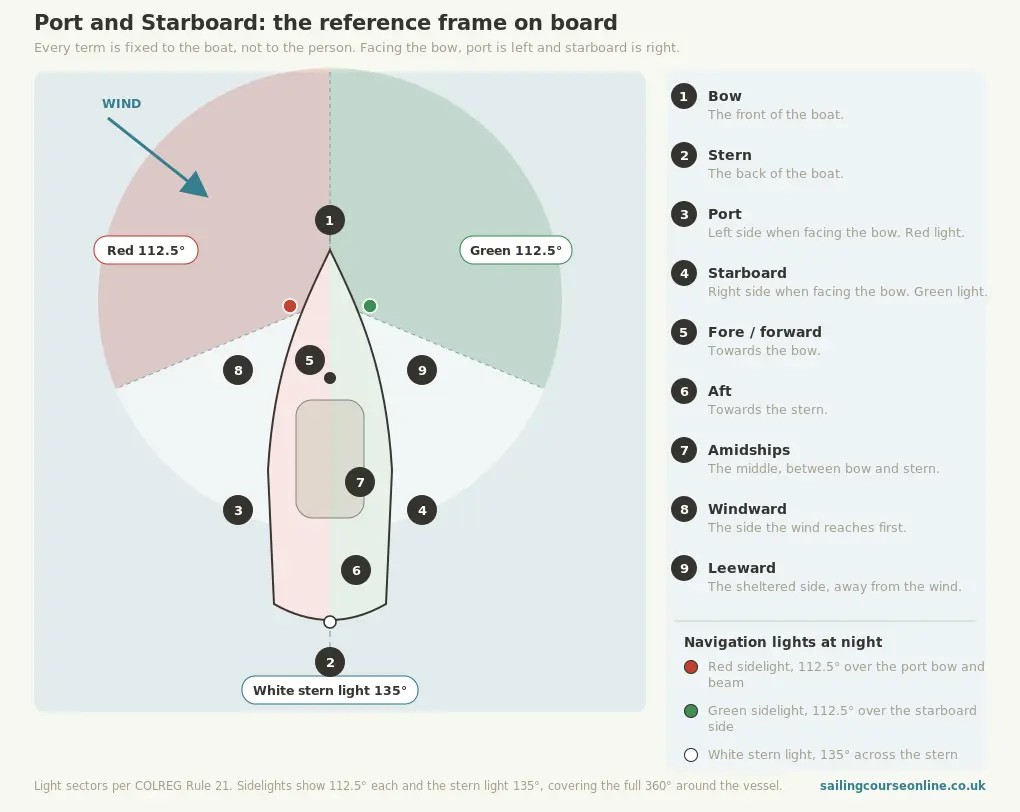
| Term | Meaning |
|---|---|
| Bow | The front of the boat |
| Stern | The back of the boat |
| Port | The left side, facing the bow |
| Starboard | The right side, facing the bow |
| Fore or forward | Towards the bow |
| Aft | Towards the stern |
| Amidships | The middle, between bow and stern |
| Windward | The side the wind reaches first |
| Leeward | The sheltered side, away from the wind |
Windward and leeward behave differently from the rest. Port, starboard, bow and stern are fixed to the hull and never move. Windward and leeward are fixed to the wind, so they swap sides every time you tack. A crew member told to move to the windward side has to look at the wind angle on the boat first, which is why instructors tend to use port and starboard for anything urgent and save windward and leeward for trimming and weight distribution.
Combine the terms and you get a position anyone on board can find. The port quarter is the aft left of the boat. The starboard bow is the forward right. Fine on the starboard bow means a little to the right of dead ahead. None of these need a pointing finger, which is the whole reason the vocabulary exists.
Where port and starboard decide who gives way
Three encounters in the collision regulations turn on which side is which, and they are the reason the words are worth more than good manners. The COLREGs were adopted by the International Maritime Organization in 1972 and carry legal force in UK waters.
| Encounter | Rule | What happens |
|---|---|---|
| Head-on, two power-driven vessels | Rule 14 | Both alter course to starboard and pass port side to port side. Neither has priority; both act. |
| Crossing, two power-driven vessels | Rule 15 | The vessel that has the other on her own starboard side gives way. |
| Two sailing vessels on different tacks | Rule 12 | The vessel with the wind on her port side gives way to the one with the wind on her starboard side. |
The crossing rule is the one most often summarised badly. If a vessel appears on your starboard side and the bearing stays steady, you are the give-way vessel and you keep clear, usually by altering to starboard and passing behind her. Some people find the road junction comparison helpful (give way to the right, as at a UK roundabout), though at sea both vessels retain a duty to avoid a collision whatever the rule says.
Rule 12 is where port and starboard stop describing a side and start describing your state. A yacht with the wind coming over her starboard side is on starboard tack and holds her course. A yacht on port tack keeps clear. It is worth working through who gives way when two vessels meet properly, because the tack rule interacts with overtaking, narrow channels and the hierarchy of vessel types in ways a single sentence cannot cover.
Port and starboard in buoyage: reading the channel
Lateral marks use the same red and green pairing to show the edges of a channel, and in UK waters a red can marks the port side of the channel as you come in from seaward. A green cone marks the starboard side. The direction of buoyage is the thing to fix in your head first, because the marks only mean anything once you know which way you are meant to be travelling.
The colours are not universal. The world is divided into two regions under the IALA Maritime Buoyage System. IALA Region A covers the UK, Europe, Africa, Australia and most of Asia, and puts red to port entering harbour. IALA Region B covers the Americas, Japan, Korea and the Philippines, and reverses it, which is where the American phrase "red right returning" comes from.
Anyone chartering abroad should check the region before leaving the dock. A skipper who has learned the UK arrangement and sails into a Region B channel on the same instinct will be on the wrong side of the buoyage, in the shallow water it was placed to keep them out of. Cardinal marks and the rest of the IALA system work the same way in both regions, which is one reason they are the more dependable mark when you are somewhere unfamiliar.
Where it goes wrong in practice
Few people forget which side is which after the first day. What causes problems is applying the words at speed, and it tends to happen in four places.
Coming alongside. A crew member told to rig fenders to starboard who rigs them to port leaves the boat unprotected on the side that meets the pontoon, and there is rarely time to move them. This is the most common way the mistake becomes expensive.
Helm orders. Under pressure people translate "port" into "left", then apply their own left rather than the boat's. Anyone facing aft while steering with a tiller has two reversals to work through at once.
Calling other vessels. A green light reported as red gives the whole crew the wrong picture of what the other vessel is doing, and the correction usually arrives late.
Passing a position by radio. Describing a casualty or a hazard as being on the left of something means nothing to a lifeboat crew approaching from a different direction. Positions go out as bearings or as sides of the vessel, which is part of why clear procedure matters when calling for help on VHF marine radio.
The habit that fixes all four is repetition in calm conditions. Naming the sides during routine jobs, when nothing is happening and nobody is under pressure, is what makes them available when something is.
Where you learn this in RYA training
Port and starboard appear in the first hour of almost every RYA course, and then keep returning in more demanding forms. The RYA Essential Navigation and Seamanship course introduces the vocabulary alongside buoyage and basic chartwork, and is the natural starting point for anyone who has not sailed before.
Day Skipper theory takes it into pilotage and the collision regulations, where you use the terms to plan an approach into an unfamiliar harbour and to work out who gives way in a real encounter. At Coastal Skipper and Yachtmaster™ Offshore theory level the work moves to night pilotage, where identifying a vessel's aspect from her lights alone becomes routine.
The RYA's own guidance on the collision regulations is a useful companion to any of these, and worth reading before a first season in charge of a boat.
Frequently asked questions
Is port left or right?
Port is the left-hand side of a boat when you are on board and facing the bow. It stays the left side no matter which way you happen to be facing, because the term is fixed to the boat rather than to the person.
Is starboard left or right?
Starboard is the right-hand side of a boat when facing the bow. At night it is marked by a green light, and in UK waters a green conical buoy marks the starboard side of a channel as you enter from seaward.
How do I remember port and starboard?
Port and left both have four letters. For the colours, the phrase "there is no red port left in the bottle" links red, port and left together in one line. As a cross-check, starboard contains two Rs, and R = Right.
Why is starboard right and port left?
Early boats were steered with an oar hung over the right side, because most people are right-handed, and that side became the steering side, or starboard. A boat with a steering oar on the right had to berth with her left side to the quay, so the left became the loading or harbour side, later shortened to port.
Why is port to the left?
Because the left was the side a boat could safely lay against a harbour wall without crushing her steering oar. It was called larboard, most likely from the loading side, until an Admiralty circular of 22 November 1844 replaced larboard with port because larboard and starboard sounded too alike when shouted.
What colours are port and starboard?
Port is red and starboard is green. The colours appear on navigation lights at night, on lateral channel buoys, and on the sail numbers and markings used in racing. Each sidelight covers 112.5 degrees of the horizon on its own side.
Do port and starboard ever change?
No. They are fixed to the vessel and never move. Windward and leeward, which describe the sides in relation to the wind, do change every time the boat tacks.
Are port and starboard used on aircraft?
Yes. Aircraft use the same terms and the same colour convention, with a red light on the port wingtip and a green light on the starboard wingtip, for the same reason ships do.
What is the opposite of port on a boat?
Starboard. Port is the left side facing forward and starboard is the right, so the two together describe the whole beam of the vessel.