A VHF marine radio is the most important piece of safety equipment on any boat after the lifejacket. It connects you directly to the Coastguard, to other vessels, and to marinas and port authorities. Unlike a mobile phone, it works when you are out of signal range, it lets you broadcast to every vessel in your area at once, and it is monitored around the clock by HM Coastguard.
Whether you are preparing for your first bareboat charter, fitting out a new boat, or working towards an RYA qualification, understanding how to use a VHF marine radio is a fundamental skill. This guide covers everything from basic setup to distress calls, UK channel allocations, and the licensing requirements you need to know.
How Does VHF Marine Radio Work?
VHF stands for Very High Frequency. Marine VHF radios operate in the frequency band between 156 and 174 MHz, which is reserved internationally for maritime communications. The signal travels in a roughly straight line from antenna to antenna, which means range is limited by the curvature of the earth and the height of your antenna.
A fixed-mount VHF radio typically transmits at up to 25 watts on high power and 1 watt on low power. At 25 watts with the antenna at masthead height on a sailing yacht, you can expect a range of around 20 to 30 nautical miles to another vessel or shore station, depending on conditions. Handheld VHF radios are limited to 5 or 6 watts, giving a more modest range of 3 to 5 nautical miles in practice, though this varies with antenna height and sea state.
VHF marine radio operates on a simplex basis for most channels, meaning only one person can talk at a time. You press the transmit button to speak, release it to listen. Some channels, including UK marina Channel 80, operate on duplex, which is worth knowing because you will only hear one side of any conversation already in progress.
About the Author
Russell Lake is an RYA Principal and founder of Sailing Course Online, based at Hamble Point Marina on the Solent. He sits on the RYA Training Committee and the British Marine Access to Boating Committee. Russell has trained personnel for the RYA and Maritime & Coastguard Agency, supported Clipper Round the World Race participants, and established Egypt's first RYA Training Centre. His offshore experience includes three RORC Fastnet campaigns as skipper and a circumnavigation of Britain by RIB. Over 50,000 students from 115 countries have completed courses through Sailing Course Online.
Learn more about our instructors
How to Set Up and Use a VHF Marine Radio
Getting started with a VHF radio is straightforward. Here is the basic process:
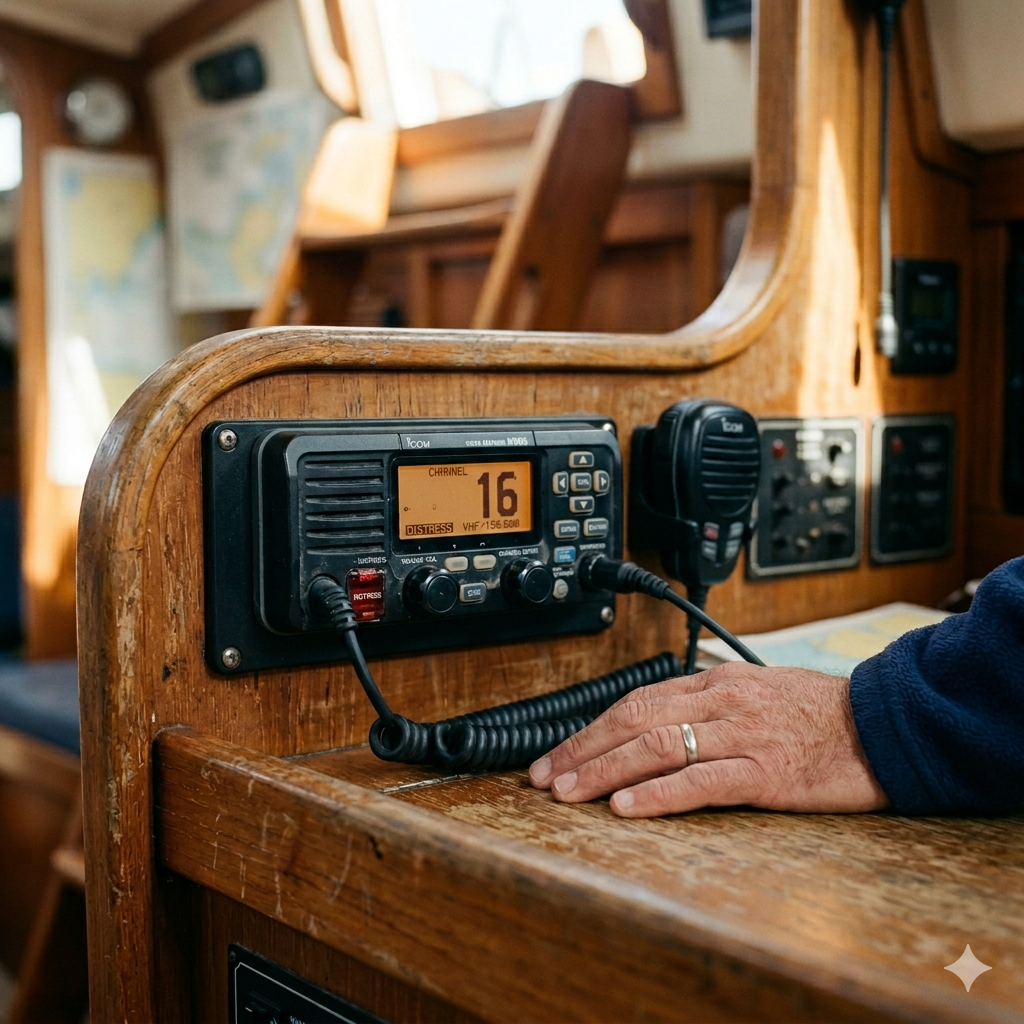
Turn the radio on and select Channel 16. This is the international distress, safety and calling channel. When you are not actively in conversation on another channel, your radio should always be monitoring Channel 16. HM Coastguard monitors it continuously.
Set the squelch. Turn the squelch control up until the background static disappears, then leave it just at that point. If you turn it too high, you may miss weaker transmissions from more distant stations.
Use low power as your default. Most VHF radios have two power settings: high (25W on a fixed set, 5-6W on a handheld) and low (1W). Always start on low power. It reduces interference and means other vessels can use the same channel a few miles away without problems. Channel 16 automatically selects high power on most radios.
Hold the microphone correctly. Keep the mic about an inch from your mouth and speak clearly in a normal voice. Shouting into the microphone causes distortion and makes your transmission harder to understand, not easier. If you are on deck, shield the microphone from the wind with your hand.
Tag your frequently used channels. Most modern VHF sets let you bookmark channels. Tag the ones you use regularly, such as your local marina channel and the Coastguard working channels for your area. Use the scan or dual-watch function to monitor Channel 16 while listening on a second channel.
VHF Marine Radio Channels in the UK
Marine VHF has over 55 international channels, but as a recreational sailor in UK waters you will use a relatively small number regularly. These are the ones worth knowing:
| Channel | Use |
|---|---|
| 16 | International distress, safety and calling. Monitor at all times. |
| 67 | HM Coastguard working channel (Small Craft Safety) |
| 80 | UK marina calling channel (duplex) |
| 06 | Ship-to-ship safety and inter-ship communications |
| 08, 72, 77 | Ship-to-ship working channels (intership) |
| M1 (37A) | Private channel, yacht clubs and small craft |
| M2 (P4) | Private channel, yacht clubs and small craft |
| 10 | Pollution, ship movement reporting |
| 13 | Bridge-to-bridge navigation safety |
| 70 | Digital Selective Calling (DSC) only. Do not use for voice. |
Local Coastguard Operations Centres each have designated working channels. Solent Coastguard, for example, uses Channel 67 as its primary small craft working channel. Check the Admiralty List of Radio Signals or the relevant almanac for the working channels in your sailing area.
When calling a marina on Channel 80, remember it is duplex. You can only hear the marina's side of any ongoing conversation, so listen for a moment before transmitting to make sure the channel is clear.
Making a Routine Call
To call another vessel or a marina, the procedure is:
Listen on the calling channel (16 for vessels, 80 for UK marinas) for at least 30 seconds to make sure it is clear. Then press the transmit button and say: the name of the station you are calling (up to three times), "this is", your vessel name (up to three times), and "over".
When the other station responds, agree a working channel to switch to. Keep Channel 16 clear for safety traffic. Once on the working channel, keep your conversation brief and to the point. A VHF radio is a shared resource, not a telephone.
Always identify yourself when transmitting. It is a condition of your radio licence, and it avoids confusion for anyone else listening on the same channel.
Mayday, Pan-Pan and Securité: Distress and Urgency Calls
There are three priority call types on VHF marine radio, and understanding the difference between them matters:
Mayday is for situations of grave and imminent danger where immediate assistance is required. Your vessel sinking, a person overboard in deteriorating conditions, or a serious fire on board would all warrant a Mayday call. This is broadcast on Channel 16.
Pan-Pan (pronounced "pahn-pahn") is for urgent situations that are not immediately life-threatening but where you need assistance. A dismasting, engine failure in a shipping lane, or a crew member with a serious but non-critical injury would be Pan-Pan situations.
Securité (pronounced "say-cure-ee-tay") is a safety message, typically used to warn other vessels about a navigational hazard, severe weather, or a large vessel manoeuvring in restricted waters.
We have written a full guide to calling for help in an emergency at sea covering the full Mayday procedure step by step, including what information to give and what to expect from the Coastguard response.
Practising these procedures before you need them is essential. On an RYA practical course, you will rehearse distress calls until the format becomes second nature. When the pressure is real, you want the words to come without thinking.
Digital Selective Calling (DSC) and MMSI
All modern fixed-mount VHF radios (and many handheld units) include Digital Selective Calling (DSC), which operates on Channel 70. DSC allows you to send a digital distress alert at the press of a button. That alert transmits your vessel's identity (via its MMSI number) and, if your radio is connected to a GPS, your position automatically. HM Coastguard receives the alert instantly.
Your MMSI (Maritime Mobile Service Identity) is a unique nine-digit number assigned to your vessel when you obtain a Ship Radio Licence. It is programmed into your VHF radio and is the digital equivalent of a call sign.
DSC can also be used to make individual calls to specific vessels (if you know their MMSI), or to make group calls. It is a powerful system, but it only works if your radio is properly set up with the correct MMSI and connected to a GPS source. Checking this setup should be part of your pre-departure routine.
DSC is part of the wider Global Maritime Distress and Safety System (GMDSS), which also includes EPIRBs and personal locator beacons and NAVTEX, all working together to ensure that a distress alert from any vessel reaches the rescue services as quickly as possible.
Do You Need a Licence for VHF Marine Radio?
Yes. In the UK, operating a VHF marine radio requires two things: a licence for the equipment, and a certificate of competence for the operator.
The Ship Radio Licence covers the radio equipment installed on your vessel. It is issued by Ofcom and has been free of charge since 2006. The licence is valid for the lifetime of the vessel and is checked for accuracy every ten years. When you apply, Ofcom will allocate your vessel a call sign and an MMSI number. You can apply online through Ofcom's Ship Radio Licence page.
If you use a handheld VHF with DSC on multiple vessels rather than a fixed installation, you will need a Ship Portable Radio Licence instead. This is also free but is limited to UK territorial waters.
The operator's certificate is the Short Range Certificate (SRC), which is the minimum legal requirement for anyone operating VHF and VHF DSC equipment on a vessel voluntarily fitted with a radio. The SRC is administered by the RYA and involves an online course followed by a practical assessment. You can get started with our RYA SRC/VHF Marine Radio course.
It is also worth knowing that the SRC is a prerequisite if you later apply for a commercial endorsement for your Yachtmaster™, so getting it done early makes sense if a professional career on the water is on your radar.
Failure to hold a valid Ship Radio Licence is a criminal offence. Both the licence and your SRC should be kept on board for inspection. Outside UK waters, foreign authorities can confiscate equipment or detain vessels that cannot produce valid radio documentation.
Can Anyone Use a VHF Marine Radio?
In a genuine emergency, yes. Anyone can use a VHF radio to make a distress call, regardless of whether they hold an SRC. The priority is always safety of life at sea.
Outside of an emergency, however, operating a marine VHF radio without holding the SRC is an offence under the Wireless Telegraphy Act 2006. The certificate exists to ensure that anyone transmitting on maritime frequencies understands correct procedures, knows how to use DSC, and will not interfere with safety communications through misuse.
This is one of the reasons we recommend that more than one person on board knows how to use the radio. If the skipper is incapacitated, another crew member needs to be able to raise the alarm. On our practical courses, we make sure every student gets hands-on time with the VHF, and the SRC course itself covers everything from routine calls to full distress procedures.
VHF Radio Tips from the Water
A few things we have learned from years of teaching and sailing on the Solent that are worth passing on:
Test your radio before you leave the marina. A quick radio check with the marina office or a nearby vessel takes 30 seconds and confirms your set is working. Do not call the Coastguard for a radio check unless no other station is available.
Brief your crew on the radio. Even if only the skipper will normally use it, every person on board should know where the radio is, how to turn it on, how to select Channel 16, and how to make a Mayday call. Keep a laminated crib card near the set with the Mayday format written out.
Monitor weather forecasts. HM Coastguard broadcasts Maritime Safety Information including weather forecasts and navigational warnings on designated VHF channels at scheduled times. Details are published in Reeds Nautical Almanac and on the Coastguard website. Listening to these as part of your passage planning routine is good practice and costs nothing.
Frequently Asked Questions
How far can a VHF marine radio reach?
Range depends primarily on antenna height. A fixed-mount radio at masthead height on a yacht will typically reach 20 to 30 nautical miles. A handheld VHF at deck level is realistically 3 to 5 nautical miles. These are line-of-sight figures and can be affected by weather, obstructions, and atmospheric conditions.
Can I use a VHF radio on inland waterways?
VHF marine radio is used on many UK inland waterways, particularly on estuaries, major rivers, and larger lakes. Specific channels are allocated for inland use. If you are navigating inland waterways where commercial traffic operates, a VHF radio is strongly recommended. You still need an SRC and a Ship Radio Licence to operate one.
What is the difference between a Ship Radio Licence and the SRC?
The Ship Radio Licence covers the equipment on your vessel and is issued by Ofcom. The SRC (Short Range Certificate) is your personal operator's qualification and is issued by the RYA after completing a course and assessment. You need both.
Do I need a VHF radio on my boat?
There is no legal requirement for recreational vessels to carry a VHF radio. However, if a radio is fitted, it must be licensed and operated by someone holding a valid SRC. From a safety perspective, carrying a VHF radio is one of the most important things you can do. A mobile phone is not a substitute for a marine radio at sea.
Can I use my VHF radio abroad?
Yes. The SRC and your Ship Radio Licence are internationally recognised. Channel allocations may differ slightly between countries, so check local regulations before you travel. Your Ship Radio Licence and SRC should be carried on board at all times.
Summary
A VHF marine radio is straightforward to use once you understand the basics: set the squelch, monitor Channel 16, keep transmissions brief, and know how to make a distress call. The UK requires both an equipment licence (free, from Ofcom) and an operator's certificate (the RYA SRC) before you transmit.
If you are new to VHF radio or need your SRC qualification, our online course covers everything from basic operation and correct procedures through to DSC and the practical assessment. It is the same qualification whether you complete it online or in a classroom, and you will have instructor support throughout.