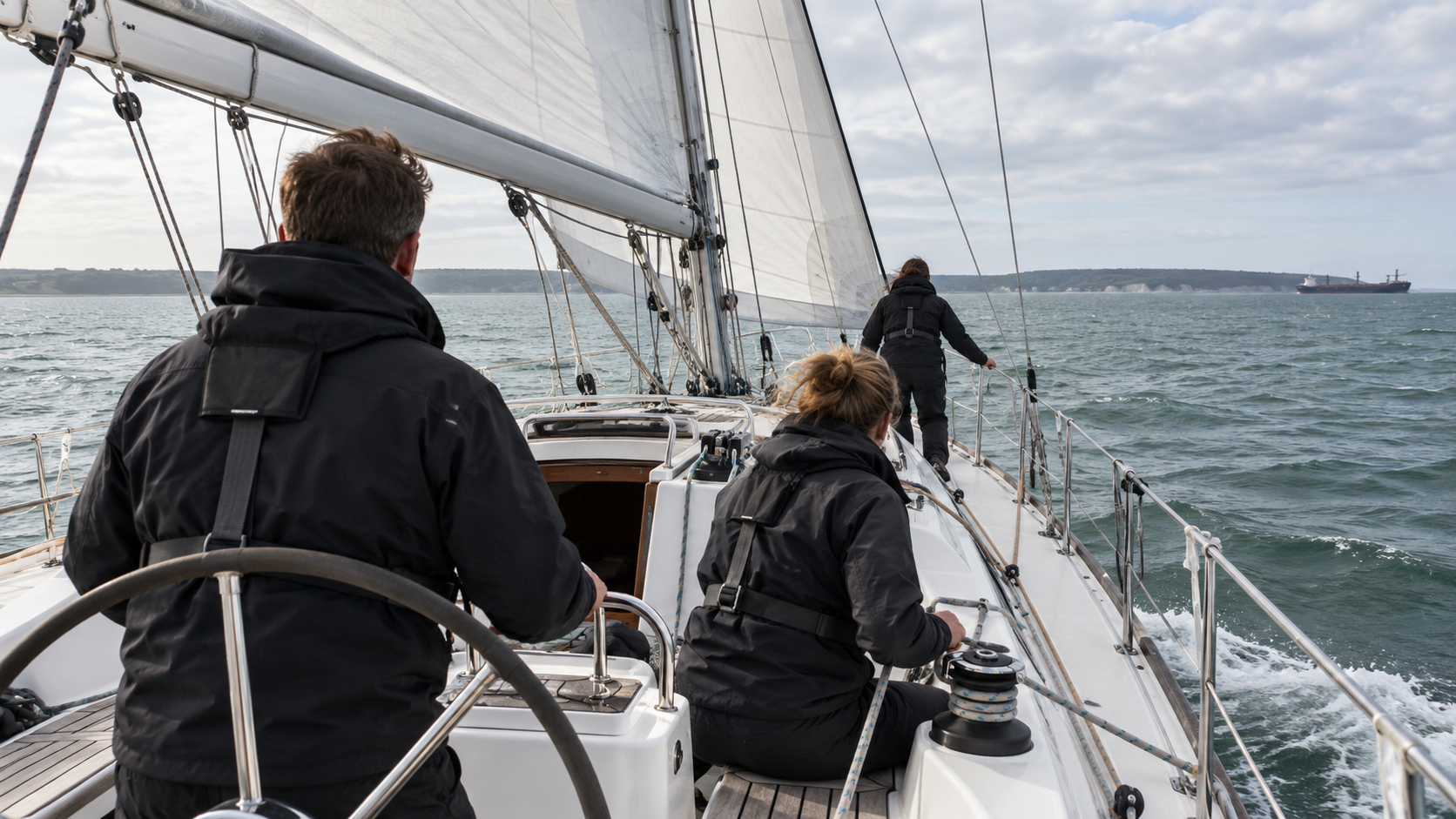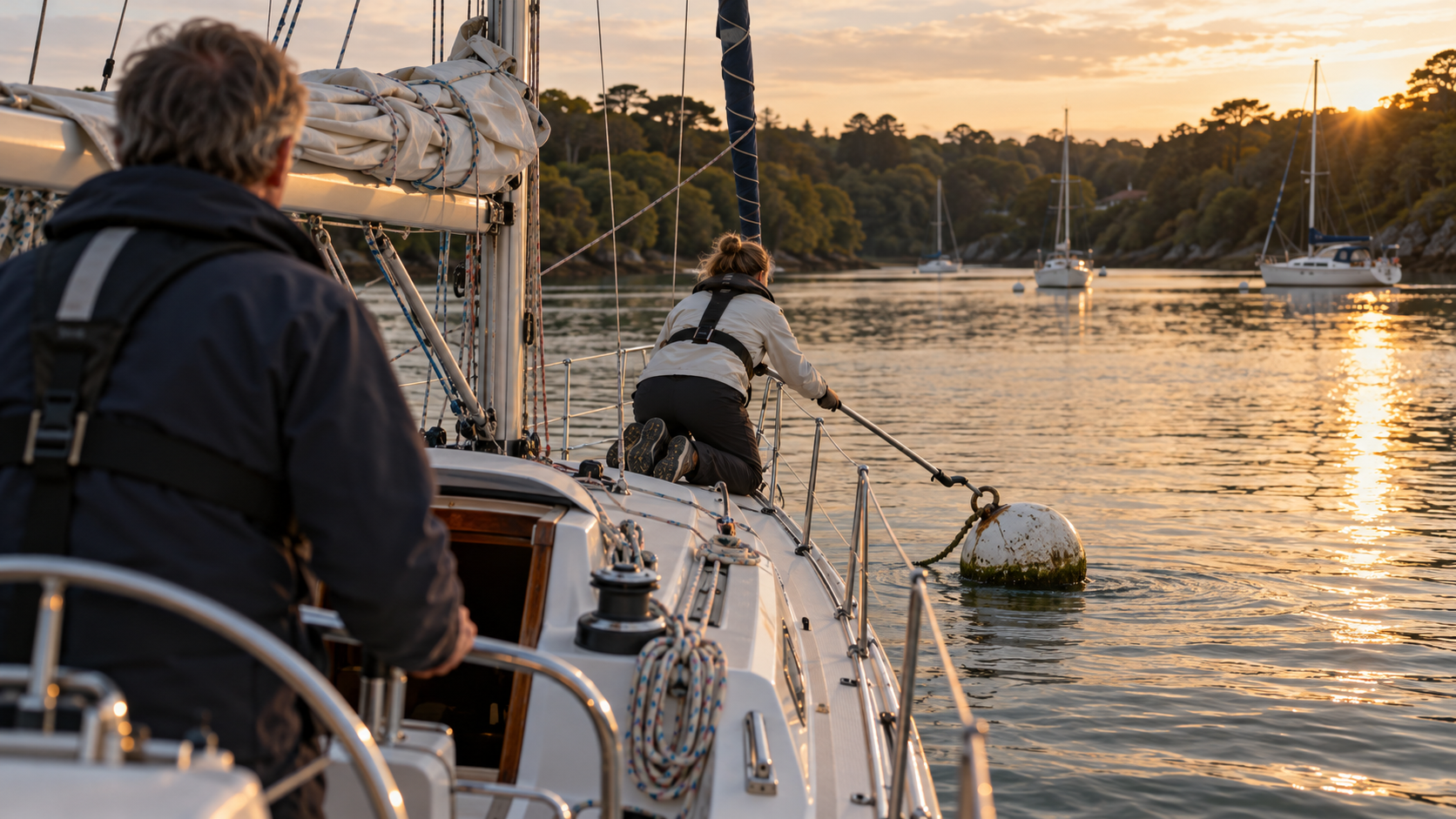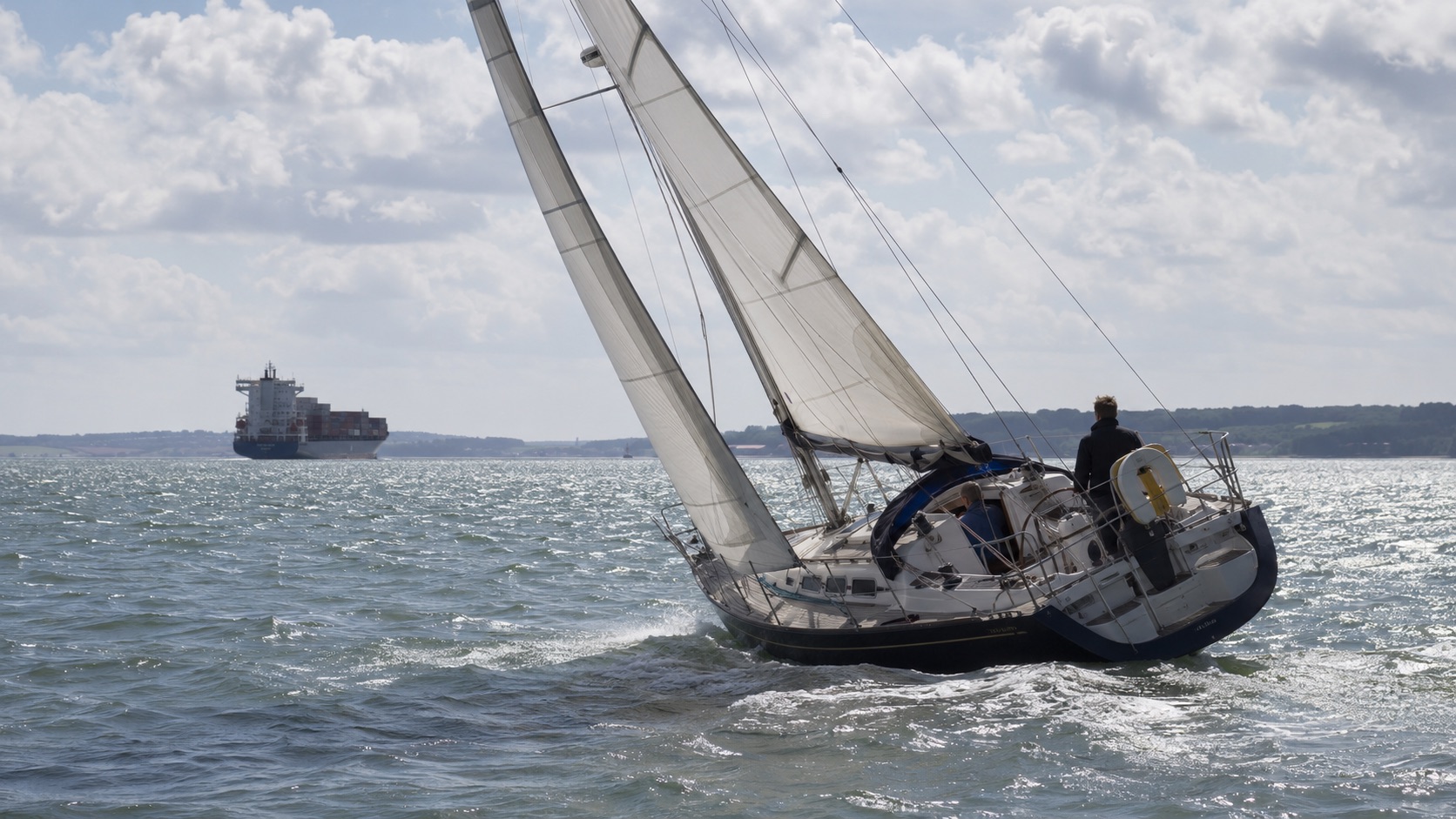
The IRPCS, also known as COLREGs, or Rules of the road at sea are a set of 41 international rules, known as the COLREGs, that decide how vessels behave when they meet so they do not collide. They cover who gives way to whom, the speed you should travel at, the lookout you must keep, and the lights, shapes and sound signals a vessel uses to show what it is doing. Think of them as the highway code of the sea. Every skipper is bound by them, from a kayaker on a river to the master of a container ship.
The full name is the International Regulations for Preventing Collisions at Sea, adopted by the International Maritime Organization in 1972. If you are working towards a Royal Yachting Association (RYA) qualification, you will meet the COLREGs early in your theory training and keep returning to them for the rest of your sailing life. This guide explains the rules that matter most on the water, sets out who gives way in the common situations you will meet, and shows where each one fits into your training.
About the Author
Richard Beniston is an RYA Yachtmaster™ Examiner for Sail and Power, and one of only 22 RYA Instructor Trainers worldwide. He has 23 years' experience in professional sailing instruction, including three RORC Fastnet campaigns as skipper, Atlantic crossings, and sail training on tall ships in the Baltic. He is Chief Instructor at Sailing Course Online, an RYA-approved online theory provider based at Hamble Point Marina, which delivers RYA Day Skipper and Coastal Skipper/Yachtmaster™ Offshore theory courses to students in over 115 countries.
Learn more about our instructors
What are the rules of the road at sea?
The rules of the road at sea are the COLREGs: the International Regulations for Preventing Collisions at Sea. They are a single, internationally agreed rulebook that tells every vessel how to act to avoid a collision, whatever its size or nationality.
The COLREGs were adopted by the International Maritime Organization in 1972 and entered into force on 15 July 1977, and are published in full by the IMO. In the United Kingdom they carry legal force through the Merchant Shipping (Distress Signals and Prevention of Collisions) Regulations 1996, set out in Merchant Shipping Notice MSN 1781. That means they are not advisory. A skipper who ignores them and causes a collision can be held responsible in law.
The rules apply to all vessels on the high seas and on all waters connected to them that seagoing vessels can navigate. A stand-up paddleboard, a fishing boat, a cruising yacht and a tanker are all bound by the same rulebook. This is why a shared, universal set of rules matters so much: two vessels approaching each other may have crews who share no common language, but they carry the same rules of the road.
The structure of the COLREGs: 41 rules in six parts
The COLREGs are made up of 41 rules divided into six parts, supported by four annexes covering technical detail such as the exact positioning of lights. You do not need to memorise all 41 to sail safely, but you do need to understand the handful that govern everyday encounters.
| Part | Covers |
|---|---|
| Part A: General | How the rules apply, definitions, and overall responsibility |
| Part B: Steering and Sailing | How vessels must behave when they meet, in all conditions of visibility |
| Part C: Lights and Shapes | The lights and day shapes vessels display to show their type and activity |
| Part D: Sound and Light Signals | Whistle, bell and horn signals for manoeuvres and restricted visibility |
| Part E: Exemptions | Transitional exemptions for older vessels |
| Part F: Verification of Compliance | Administrative provisions for flag states |
Part B, Steering and Sailing, is the part you will use most as a skipper. It contains the rules on lookout, safe speed, risk of collision and actions required to avoid them. The sections below walk through the ones that come up again and again.
Rule 5: keep a proper lookout
Rule 5 requires every vessel to keep a proper lookout at all times, by sight and hearing and by every other available means. It is the first of the steering and sailing rules for a reason. Almost every collision involves a lookout that failed in some way.
A proper lookout is more than glancing forward now and then. It means scanning the whole horizon regularly, including behind you, and using your ears as well as your eyes in fog or at night. It also means using the tools on board. Radar and AIS, the Automatic Identification System that shares vessel positions, both count as part of a proper lookout, and Rule 7 expects you to use them if you have them. On a cruising yacht, that often means treating AIS as a lookout aid rather than a novelty.
The Marine Accident Investigation Branch has repeatedly identified a failure to keep a proper lookout as a recurring factor in the collisions it investigates. A phone in the cockpit, a task below deck, or an autopilot lulling the crew are all common causes. Rule 5 is short, but it is the rule that prevents the most incidents. The RYA sets out the same priorities in its own guidance on the COLREGs for leisure sailors.
Rule 6: proceed at a safe speed
Rule 6 requires every vessel to proceed at a safe speed so it can take proper action to avoid a collision and stop within a distance suited to the conditions. Safe speed is not a fixed number. It depends on the situation around you.
The rule lists the factors you must weigh: visibility, the amount of traffic, how well your vessel manoeuvres and stops, background light at night, the state of wind and sea, and the range of your radar. In thick fog in a busy estuary, a safe speed may be very slow. On a clear day in open water, it may be your full cruising speed. Judging conditions well, including reading the wind and sea state, is part of setting a safe speed.
Rule 7: risk of collision
Rule 7 tells you how to work out whether a risk of collision exists. If you are in any doubt, you must assume that it does and act accordingly.
The classic test is the compass bearing. Take a bearing of the approaching vessel, then take it again a short time later. If the bearing does not change and the range is closing, you are on a collision course. A steady bearing with decreasing distance is the warning sign every skipper learns to watch for. Rule 7 also tells you to use radar properly if it is fitted, including long-range scanning and plotting, which is where radar earns its place in collision avoidance.
Rule 8: action to avoid a collision
Rule 8 says that any action you take to avoid a collision must be positive, made in good time, and large enough to be obvious to the other vessel. A series of small alterations is discouraged. A single, clear change of course or speed that the other skipper can see and understand is what the rule wants.
If you need to give way, do it early and do it clearly. Altering course by a token five degrees rarely tells the other vessel what you intend. A bold alteration removes any doubt and leaves plenty of sea room.
The steering and sailing rules: who gives way to whom
When two vessels meet, the COLREGs decide which one keeps clear. The vessel that must keep clear is the give-way vessel. The one that holds its course and speed is the stand-on vessel. Knowing which you are is the heart of the rules of the road.
It is also important to remember that both vessels have a duty to avoid collisions, which is why there is no "right of way" at sea.
Three encounters between power-driven vessels come up constantly.
Head-on (Rule 14). When two power-driven vessels meet head-on, or nearly so, both alter course to starboard and pass port side to port side. Neither has priority. Both act.
Crossing (Rule 15). When two power-driven vessels cross, the vessel that has the other on its own starboard side gives way. A useful memory aid: if the other boat is on your right, you give way, much as you would at a road junction.
Overtaking (Rule 13). Any vessel overtaking another must keep out of the way of the vessel being overtaken, and this holds regardless of vessel type. An overtaking vessel does not gain right of way simply because the vessel ahead is under power and it is under sail.
Sailing vessels: port and starboard tack
Rule 12 governs two sailing vessels meeting. When each has the wind on a different side, the vessel with the wind on its port side gives way. When both have the wind on the same side, the vessel to windward gives way to the one to leeward. In short, starboard tack has right of way over port tack, and this is one of the first rules a sailor commits to memory.
Rule 18: the pecking order
Rule 18 sets out the hierarchy of responsibility between different types of vessel. In general, a more manoeuvrable vessel keeps clear of a less manoeuvrable one. The order below runs from the vessel with the greatest priority to the least.
| Priority | Vessel type |
|---|---|
| Highest | Vessel not under command (unable to manoeuvre, for example broken down) |
| Vessel restricted in its ability to manoeuvre (for example laying cables or dredging) | |
| Vessel constrained by its draught | |
| Vessel engaged in fishing (with nets or gear deployed) | |
| Sailing vessel | |
| Lowest | Power-driven vessel |
This is the source of the well-known idea that power gives way to sail. It is true as a general rule, but it sits inside a wider hierarchy, and it comes with an important exception in narrow channels, covered next. A cruising yacht under sail has no priority over a ferry that is constrained by a narrow channel.
Narrow channels and traffic separation schemes
Rules 9 and 10 change the picture in confined and busy waters, and they often catch out newer skippers. In a narrow channel, Rule 9 requires you to keep to the starboard side. A vessel under 20 metres, or a sailing vessel, must not impede a larger vessel that can only navigate safely within the channel. That overrides the general power-gives-way-to-sail idea.
Rule 10 governs traffic separation schemes, the marked shipping lanes off headlands and in busy approaches. If you must cross one, you cross on a heading as near as practicable to a right angle to the flow, so you spend the least possible time in the lane and your intentions are clear to shipping. Both rules are worth thinking through at the chart table, which is why they belong in any thorough passage planning.
Lights, shapes and sound signals
Parts C and D of the COLREGs let vessels communicate at night, in poor visibility, and when a manoeuvre needs signalling. Learning to read them is what lets you apply the give-way rules in the dark.
Lights (Part C) tell you a vessel's type, size and aspect at night. A red port light and a green starboard light, with white masthead and stern lights, show you which way a power-driven vessel is heading and whether you are looking at its port or starboard side. Extra lights mark special cases, such as the red-over-white of a vessel engaged in fishing. Day shapes do the same job in daylight, for example the ball, diamond, ball of a vessel restricted in its ability to manoeuvre.
Sound signals (Part D) announce manoeuvres and warn of danger. One short blast means "I am altering course to starboard", two short blasts means "to port", and five or more short blasts is the signal that says "I do not understand your intentions" or "I doubt you are taking enough action". In restricted visibility, vessels sound fog signals. Getting comfortable with signalling goes hand in hand with confident use of a VHF marine radio.
Common mistakes skippers make
After years of examining, the same errors come up again and again, and most trace back to a few rules.
The first is a lookout that lapses. A skipper fixed on the chart plotter, or a crew all below at lunchtime, is the setup for a close encounter that Rule 5 exists to prevent. The second is timid give-way action. A small, late alteration that the other vessel cannot read is worse than a bold one made early, which is the whole point of Rule 8. The third is misreading the narrow-channel exception, with a sailing skipper assuming priority over a ship that physically cannot leave the dredged channel.
A worked example from the Solent shows how the rules stack up. A yacht sailing across the shipping channel off the Bramble Bank meets a container ship inbound to Southampton. The yacht is under sail, so a beginner might assume priority. In fact, the ship is constrained to the channel, so under Rules 9 and 18 the yacht must keep clear, cross briskly and avoid impeding it. Reading the situation correctly is the difference between a routine crossing and a frightening one.
How the rules of the road are taught in RYA theory
The COLREGs run right through RYA shorebased theory, which is where most sailors first learn to apply them properly rather than just recite them. You meet the core rules on the RYA Day Skipper theory course, alongside chartwork, tides and passage planning. The course builds the give-way rules into practical scenarios, so you leave able to work out who keeps clear in a real encounter.
At the next level, the RYA Coastal Skipper and Yachtmaster™ Offshore theory course goes deeper into lights, shapes, sound signals and collision avoidance at night and in poor visibility. By the time you sit a Yachtmaster™ practical exam, an examiner will expect you to apply the rules instinctively, in the dark, while managing everything else on the boat. Learning them thoroughly ashore is what makes that possible afloat.
Frequently asked questions
What does COLREGs stand for?
COLREGs stands for the Convention on the International Regulations for Preventing Collisions at Sea, adopted by the International Maritime Organization in 1972. The name is often shortened to the collision regulations or the rules of the road at sea.
What is the most important rule of the road at sea?
Rule 5, keeping a proper lookout, is widely regarded as the most important, because almost every collision involves a lookout that failed. Rule 2, which reminds skippers that they remain responsible for taking action even when a rule seems to give them priority, sits close behind it.
Do the rules of the road apply to small boats and kayaks?
Yes. The COLREGs apply to all vessels, including kayaks, paddleboards, dinghies and tenders. A small craft is still expected to keep a lookout, travel at a safe speed and keep clear where the rules require it.
What does port and starboard mean for converging sailing vessels?
Starboard is the right-hand side of a vessel when facing forward, and port is the left. When two sailing vessels meet on different tacks, the one on starboard tack, with the wind on its starboard side, has priority, and the vessel on port tack keeps clear.
What is Rule 7 of the COLREGs?
Rule 7 covers how to determine whether a risk of collision exists. It tells you to use all available means, including a steady compass bearing and radar, and to assume a risk exists if you are in any doubt.