Last updated: November 2026
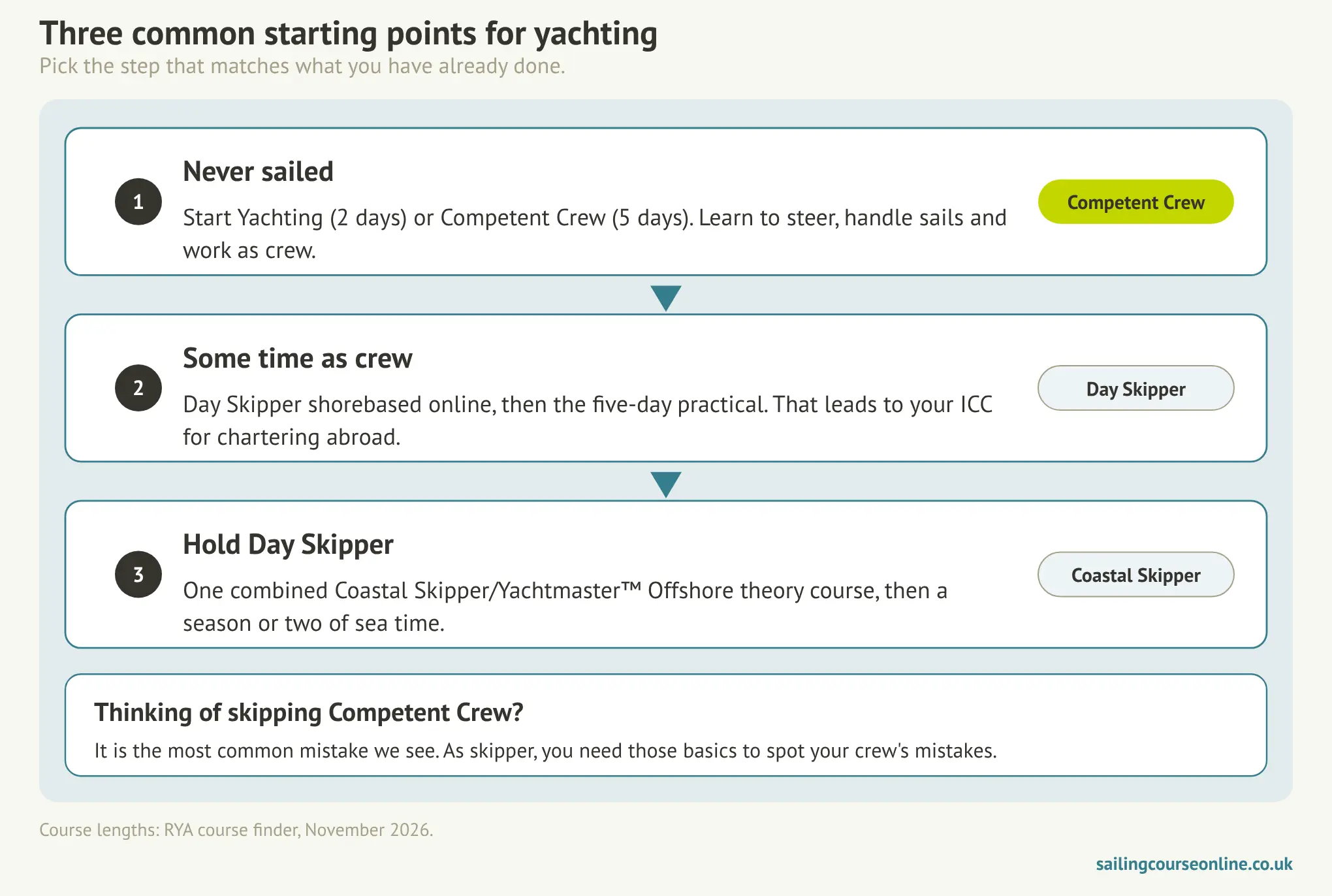
Which RYA course you should do depends on four things: the boat you want to be on, how much you have already done, what you want the training to let you do, and how much navigation you know. For most people heading for yachts, the answer is one of three starting points. If you have never sailed, start with Competent Crew or the shorter Start Yachting. If you have some time on the water and want to skipper, start the Day Skipper Shorebased course now and schedule your practical. I still recommend Competent Crew first if you have not done it, because as skipper you will need those basics to spot your crew's mistakes. If you already hold Day Skipper, the next step is the Coastal Skipper/Yachtmaster™ Offshore theory.
The table below answers the question at a glance. Use the four questions underneath it to get one recommendation for your situation, then read your route for the detail.
Which RYA course is right for you? The short answer
Find your situation in the left column. Or answer the four questions below for one recommendation.
| Your situation | Start with | Then |
|---|---|---|
| Never sailed, want to try yachts | Start Yachting (2 days) or Competent Crew (5 days) | Day Skipper Shorebased |
| Some time as crew, want to skipper | Day Skipper Shorebased | Day Skipper practical (5 days) |
| Want to charter a yacht abroad | Day Skipper Shorebased | Day Skipper practical and SRC radio licence, then apply for an ICC |
| Own boat, want to navigate it safely | Day Skipper Shorebased | Own boat tuition or Day Skipper practical |
| Already hold Day Skipper | Coastal Skipper/Yachtmaster™ Offshore theory | Coastal Skipper practical |
| Aiming for Yachtmaster™ or paid work | Fastrack to Yachtmaster™ | Sea time, then the Yachtmaster™ exam |
| Powerboat, RIB or dinghy | Powerboat Level 2, or a local sailing club course | Day Skipper Shorebased for longer trips |
About the Author
Richard Beniston is Chief Instructor at Sailing Course Online and an RYA Yachtmaster™ Examiner for Sail and Power, with 23 years' experience teaching, examining and skippering yachts. His sea time includes three RORC Fastnet campaigns as skipper and Atlantic crossings. Sailing Course Online is an RYA-approved online theory provider based at Hamble Point Marina, and over 50,000 students from 115 countries have completed courses with it.
Learn more about our instructors
Find your starting point
Each route below opens with the recommendation, then explains why and what comes next. Pick the one that sounds most like you.
I have never sailed and want to try yachting
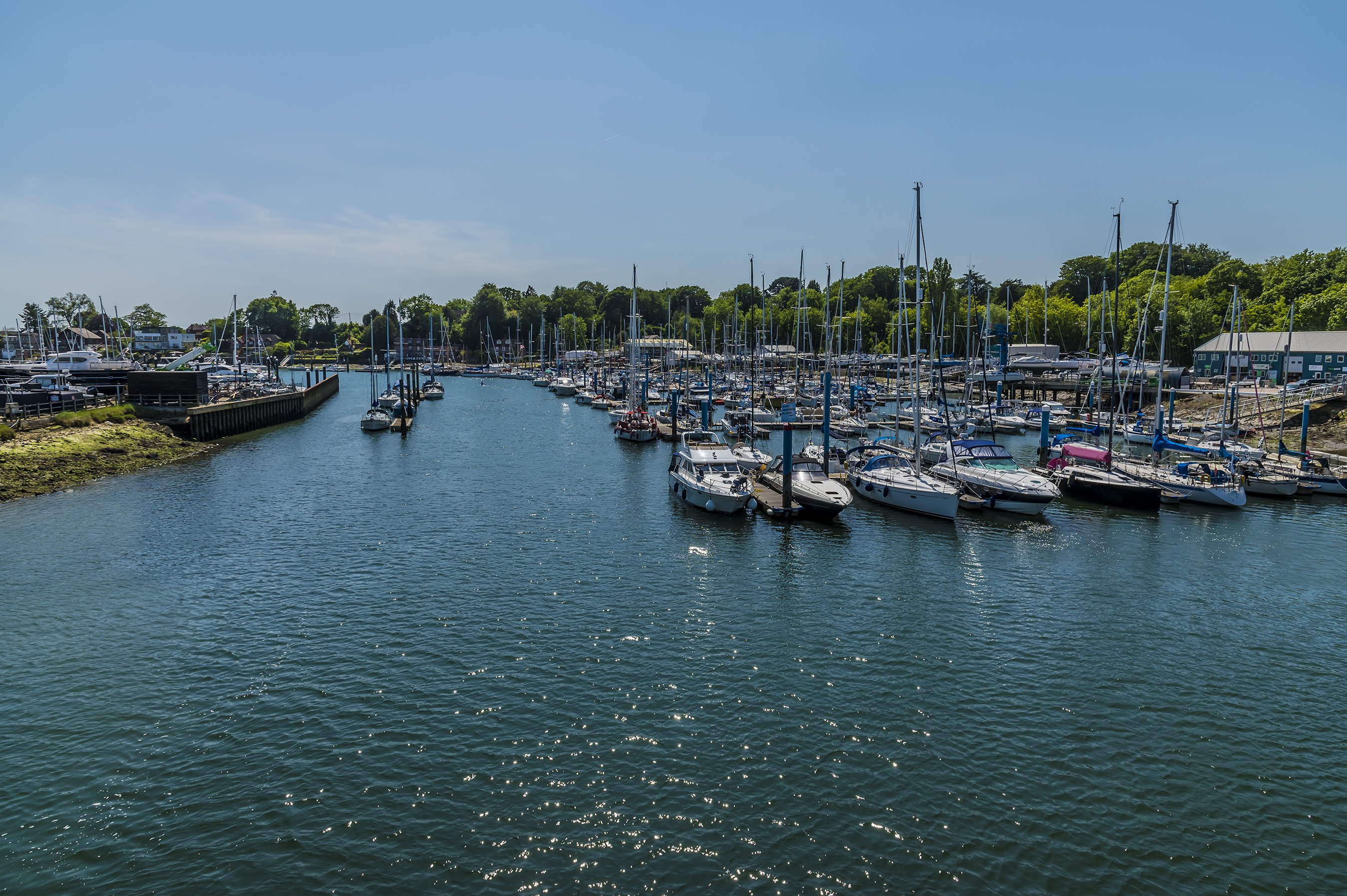
Start with Competent Crew, or Start Yachting if you want a shorter taster first. Competent Crew is a five-day practical course that teaches you to steer a compass course, handle sails and ropes, and work safely as part of a crew. Start Yachting covers the basics in two days, and if you enjoy it, Competent Crew can then be completed in another three days. Our sister school Urban Truant runs both from Hamble Point Marina on the Solent.
Neither course needs any theory. If you already suspect you will want to skipper one day, starting the shorebased reading early does no harm, because it makes the practical weeks easier to follow. Our guide explains what a Competent Crew week involves.
I have crewed a bit and want to skipper
Start the Day Skipper Shorebased course, and schedule the five-day Day Skipper practical. The Shorebased course covers chartwork, tides, weather, the collision regulations and passage planning. The RYA puts it at around 40 hours of study, finished with two exam papers, and most of our students complete it in two to three months alongside work.
The RYA's recommended experience before the practical is 5 days at sea, 100 miles and 4 night hours (RYA course finder, November 2026). Many people have this from a Competent Crew week or from crewing for friends. You can start the online Day Skipper theory course today with a free 24-hour trial, and our guide to Shorebased or practical first covers how to time the two halves.
I want to charter a yacht abroad
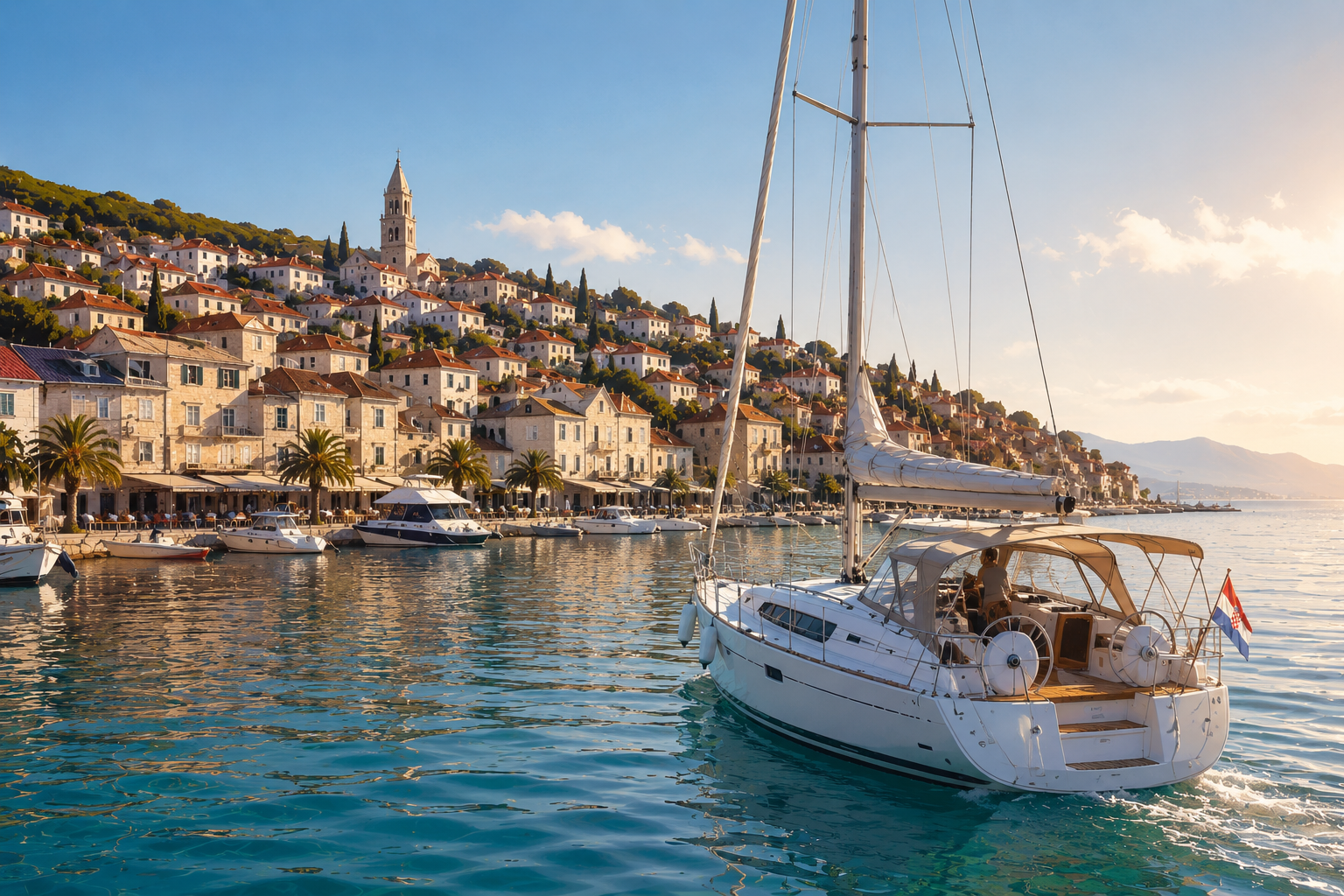
Aim for the Day Skipper practical certificate, then apply for an International Certificate of Competence (ICC). Most bareboat charter companies in the Mediterranean ask for a Day Skipper practical certificate or an ICC, and in countries such as Croatia and Greece the ICC is what officials expect to see. The ICC is issued on the strength of the practical, so the Shorebased course comes first and the practical week second.
For someone who will only ever charter in Greece or Croatia, I recommend Competent Crew first unless you already have the experience, then the Day Skipper Shorebased course and the five-day practical, coupled with a VHF/SRC radio licence. That gives you both the experience and your ICC.
Many charter companies also want one person aboard to hold a VHF radio licence, and it is a legal requirement, so add the Short Range Certificate (SRC) to your plans. Our guide to qualifications to charter a yacht abroad covers what different countries ask for, and the ICC guide explains how to apply.
I have my own boat and want to navigate it safely
Take the Day Skipper Shorebased course, or Essential Navigation and Seamanship if you only plan short trips close to home. Essential Navigation is a short introduction of about 8 to 10 hours online. It covers chart basics, buoyage and simple pilotage, and suits someone pottering along a familiar stretch of coast. Day Skipper goes much further into tides, course to steer, weather and passage planning, and in my experience is the level most owners end up wanting once they start making longer trips.
If you are torn between the two, we compare them side by side. Owners of motor cruisers follow the same theory courses; the practical side is usually own boat tuition on your own vessel.
I already have Day Skipper and want to go further
Your next course is the Coastal Skipper/Yachtmaster™ Offshore Shorebased theory. It is one combined course that covers the theory for both Coastal Skipper and Yachtmaster™ Offshore, so you only study it once. Expect around 50 to 60 hours, going further into offshore weather, passage planning and the full collision regulations.
The RYA's recommended experience before the Coastal Skipper practical is 15 days at sea (2 as skipper), 300 miles and 8 night hours (RYA, November 2026). I usually see people sail independently for a season or two after Day Skipper before they get there. Day Skipper vs Coastal Skipper sets out the differences in full.
I want Yachtmaster™ or to work on boats
Take Fastrack to Yachtmaster™, which bundles three Shorebased courses from Day Skipper through to Yachtmaster™ Offshore and includes the VHF/SRC radio course, then build sea time towards the exam. Buying the theory as one programme suits people who already know where they are heading, such as those planning a career afloat.
The theory is the quicker part. The time it takes depends mostly on how fast you can log the miles and days the exam requires, and how long it takes to become a Yachtmaster™ works through three realistic starting points. If you plan to skipper for pay, you will also need a commercial endorsement.
I want to drive a powerboat or RIB, or sail dinghies
For powerboats and RIBs, start with Powerboat Level 2. For dinghies, start with a local sailing club course. Powerboat Level 2 is the standard two-day course for powerboats and RIBs, and it can lead to an ICC for powerboats. Urban Truant runs it on the Solent.
Neither we nor Urban Truant teach dinghy sailing, so the RYA's own finder is the place to look for a club or centre near you. If you later head further offshore in a powerboat, the Day Skipper Shorebased course is the next step in navigation.
Can you skip a course?
You can, though I rarely recommend it. The RYA scheme lets you start at the level that matches your experience, and Competent Crew is not a formal requirement for Day Skipper. What the courses do require is that you arrive able to do what the level below teaches. A Day Skipper practical assumes you can already steer, handle lines and work as useful crew, and that you know the Shorebased material. A Coastal Skipper week assumes you have made skippering decisions on your own.
Skipping Competent Crew is the most common mistake I see in the order people take their courses.
"I've seen very competent sailors make mistakes during Yachtmaster™ exams due to skipping the basics."
The test I would apply is simple: could you do, without help, what the course below expects you to finish with? If you have crewed for friends for a few seasons, sailed at night and know your way around a chart, going straight to Day Skipper makes sense. If your experience is a few sunny afternoons as a passenger, a Competent Crew week will save you a frustrating and tiring practical.
Think about what happens once you have your Day Skipper practical. The first thing most people want to do is set sail with friends and family, and at that point you are the most experienced person aboard, so you are the skipper and the instructor. The mistakes your crew make are the ones Competent Crew teaches, and you need to know those basics to spot them.
The practical courses run to a full syllabus over five days. There is little room to teach crewing or chartwork from scratch, so a student who arrives without them spends the week catching up, with less time left for skippering. Our guide to what Day Skipper qualifies you for explains what you will be signed off to do at the end.
Where the theory fits, and why it usually comes first
I recommend doing the Shorebased course before the practical whenever you can. Every practical day starts with a plan: the forecast, the tidal gates, a safe arrival time. In my experience, students who arrive with the theory done spend their week on boat handling and decisions, which you can only learn afloat.
Studying online lets you start whenever suits you and work through the modules in the evenings. You can try the course free for 24 hours before committing, and if you are weighing up formats, we compare online and classroom study. The exam is two papers at the end, which we explain in our guide to the theory exam.
For the whole ladder from Competent Crew to Yachtmaster™ Ocean, see how the RYA levels fit together.
Frequently asked questions
Can I learn to sail at 50 or 60?
Yes. There is no upper age limit on any RYA course, and many people start yachting in their fifties and sixties. The main thing to check is that you are comfortable moving around a boat that heels and moves; instructors will adapt the pace to you.
Should I skip Competent Crew?
You can, because Competent Crew is not a formal requirement for Day Skipper, though I rarely recommend it. Once you have your Day Skipper practical, you will be the skipper and the instructor when you take friends and family sailing, and Competent Crew teaches the basics you need to spot their mistakes. If you have crewed for a few seasons and sailed at night, going straight to Day Skipper can make sense.
Is the Day Skipper Shorebased course hard?
Most of it is not. The parts I see students find hardest are tidal heights and course to steer, which usually need working through more than once. Our guide to the two exam papers explains where marks tend to be lost.
Do RYA certificates expire?
RYA course completion certificates, including Competent Crew, Day Skipper and the Shorebased certificates, do not expire. Your skills fade without use, so I recommend a refresher before a charter after a long gap.
Do I need a licence to sail in the UK?
Not for private leisure sailing at sea. Training is voluntary in the UK, but charter companies, insurers and other countries will ask for proof of competence. Our guide to whether you need a boat licence covers the exceptions, including inland waterways and VHF radio.
How long does it take to go from beginner to Day Skipper?
Most people take one sailing season. A typical route is a Competent Crew week in spring, the Shorebased course over the following two to three months, and the Day Skipper practical in late summer, with some crewing in between to build the recommended miles.