
Aug 06, 2026
Cardinal Marks Explained: How to Read Them at Sea
Russell Lake


A cardinal mark is a black and yellow buoy or beacon that tells you where the safe water lies in relation to a hazard, using the four points of the compass. Pass north of a north mark, east of an east mark, south of a south mark and west of a west mark, and you will stay in navigable water. The mark takes its name from the side of the danger on which the good water is found, so a north cardinal always has the hazard lying to its south.
Cardinal marks are part of the IALA Maritime Buoyage System, the international scheme run by the International Association of Marine Aids to Navigation and Lighthouse Authorities. In UK waters they are maintained by Trinity House, which introduced System A in 1977 and today looks after around 450 buoys.
This guide covers what each of the four marks looks like by day, what it does at night, how to remember the whole system without a chart in front of you, and what to do when one appears on your bow.
About the Author
Russell Lake is an RYA Principal and founder of Sailing Course Online, based at Hamble Point Marina on the Solent. He sits on the RYA Training Committee and the British Marine Access to Boating Committee. Russell has trained personnel for the RYA and Maritime & Coastguard Agency, supported Clipper Round the World Race participants, and established Egypt's first RYA Training Centre. His offshore experience includes three RORC Fastnet campaigns as skipper and a circumnavigation of Britain by RIB. Over 50,000 students from 115 countries have completed courses through Sailing Course Online.
Learn more about our instructors
What is a cardinal mark?
A cardinal mark indicates where the best and safest water lies, and it is read together with a compass. Unlike a channel marker, it does not depend on which way you are travelling. A north cardinal means the same thing whether you are inbound or outbound, coming from the east or the west.
Cardinal marks are used in three situations. They show the deepest water in an area, they show the safe side on which to pass a danger, and they draw attention to a feature in a channel such as a bend, a junction or the end of a shoal.
They also do duty as wreck markers. Trinity House uses cardinal buoys for permanent wreck marking, placing north, east, south and west marks around the wreck. For a new wreck, one of those buoys may be duplicated and fitted with a radar beacon, or RACON, so it shows up clearly on radar.
The four cardinal marks: colours and topmarks
Every cardinal mark carries two black cones as a topmark, and the cones always point towards the black band on the buoy. Learn that one rule and the colours follow automatically, which is important because topmarks are visible far sooner than colour detail through binoculars.
| Mark | Topmark (two black cones) | Colour | Safe water lies |
|---|---|---|---|
| North | Both cones pointing up | Black above yellow | To the north of the mark |
| East | Cones base to base | Black, yellow, black | To the east of the mark |
| South | Both cones pointing down | Yellow above black | To the south of the mark |
| West | Cones point to point | Yellow, black, yellow | To the west of the mark |
The cones on a north mark point up, and the black band sits at the top. The cones on a south cardinal point down, and the black band sits at the bottom. East has its cones base to base, giving a wide middle and a black band at each end. West has its cones point to point, giving a narrow middle and a black band across the centre.
The buoys themselves are substantial. A Trinity House Type 2 cardinal buoy is around three metres in diameter and weighs roughly six tonnes before moorings are added.
How to remember the cardinal marks
Three memory aids cover the whole set, and most sailors end up using all three.
The cones point to the black. This is the one to learn first, because it works in every case and needs nothing else. If you can see which way the cones point, you know where the black band is, and you know which mark you are looking at.
West is a waistband. The west mark has its black band around the middle, like a belt, and its cones meet point to point to form a narrow waist. Some sailors prefer the wine glass image, since the two cones together look like a glass on a stem.
East is an egg. The east mark has yellow in the middle with black top and bottom, and the cones base to base form an egg shape. North and south then look after themselves: the cones point the way you should go.
Cardinal mark lights: what the flashes mean
At night a cardinal mark shows a white flashing light, and the number of flashes tells you which mark it is. All four use quick flashing (Q) or very quick flashing (VQ), and the count follows a clock face: north at twelve, east at three, south at six and west at nine.
| Mark | Quick flashing | Very quick flashing | Clock position |
|---|---|---|---|
| North | Q (continuous) | VQ (continuous) | Twelve o'clock |
| East | Q(3) 10s | VQ(3) 5s | Three o'clock |
| South | Q(6) + LFl 15s | VQ(6) + LFl 10s | Six o'clock |
| West | Q(9) 15s | VQ(9) 10s | Nine o'clock |
Read the notation as follows. Q(3) 10s means three quick flashes, then a pause, with the whole pattern repeating every ten seconds. LFl is a long flash, held for at least two seconds. All cardinal lights are white, which separates them at a glance from the red and green of channel markers.
Counting flashes at sea takes practice. In a seaway you may lose the first flash of a group behind a wave, so it pays to watch a mark through two or three full cycles before committing to an identification.
Why the south cardinal has a long flash
The south mark adds a long flash after its six quick flashes so it cannot be mistaken for a west mark. Six and nine are easy to confuse at distance, particularly if you miss a flash or two in poor visibility. The long flash is unmistakable, so once you see it you know you are looking at a south cardinal without having to count accurately.
Why the north cardinal breaks the pattern
North does not fit the clock face because twelve flashes would take too long to count and would be hard to distinguish from a continuous light. Instead the north mark flashes continuously, with no group and no pause. An uninterrupted white quick flash with no rhythm to it is a north cardinal.
Which side do you pass a cardinal mark?
Pass on the side the mark is named after. Go north of a north mark, east of an east mark, south of a south mark and west of a west mark. The danger lies on the opposite side, so a north cardinal has the hazard to its south, and you keep to the north of it.
How to use a cardinal mark in practice
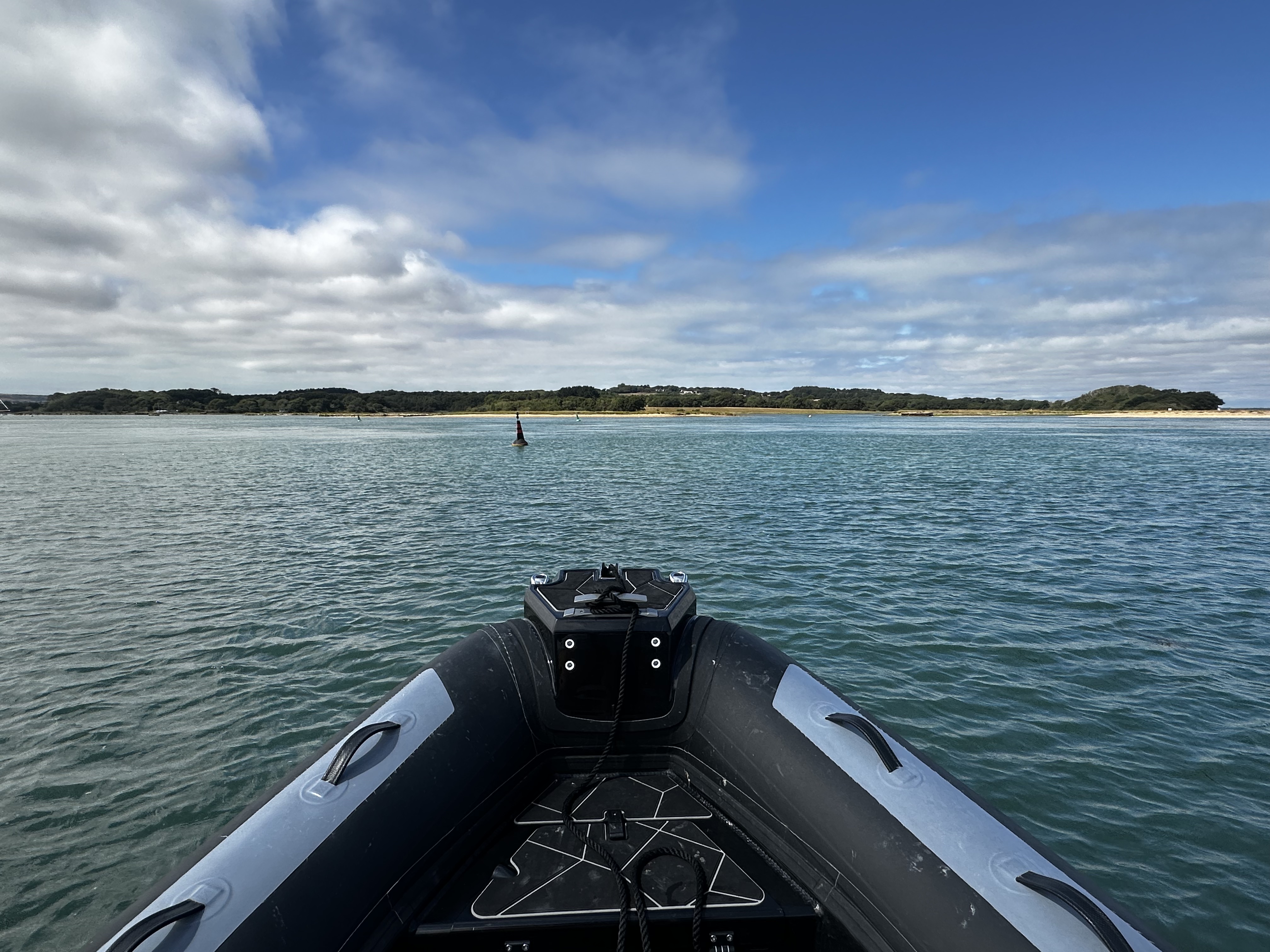
Identifying the mark is only half the job. Once you know which cardinal you are looking at, you need to decide how much room to give it, and the mark itself will not tell you that.
A cardinal gives you a direction and leaves the distance to you. It sits at the edge of the danger it guards, so passing close on the correct side is correct, but perhaps a little more respect is advisable. Double check the depth on the chart and make a sensible, safe decision. Take a bearing, check the chart for the extent of the shoal or wreck behind the mark, and set a clearing distance that accounts for tidal set pushing you back towards it.
Several cardinals working together tell you more than one on its own. A north mark and a south mark either side of the same patch bracket the hazard between them, and the gap is the channel. Where you see cardinals in a ring, you are almost certainly looking at a wreck.
A Solent example makes the point. Approaching the Bramble Bank on a rising tide, a west cardinal marks the western end of the shallows, so you keep west of it. With a spring tide setting hard across your track, the cost of getting that wrong is sitting on the Bramble Bank waiting six hours for the water to come back, which is a well-attended local tradition and one worth watching rather than joining. Reading the mark correctly is straightforward, and building the clearance into the plan beforehand is part of planning a passage properly.
Cardinal marks and lateral marks: what is the difference?
Cardinal marks are absolute and lateral marks are relative. A cardinal mark points to safe water using the compass and means the same thing from every approach. A lateral mark shows the edge of a channel and only makes sense once you know the direction of buoyage, which normally runs into a harbour from seaward or upstream in a river.
| Cardinal mark | Lateral mark | |
|---|---|---|
| Tells you | Where the safe water lies by compass | Which side of the channel you are on |
| Depends on direction of travel | No | Yes |
| Colours | Black and yellow | Red or green |
| Light colour | White | Red or green |
| Topmark | Two black cones | Can (port) or cone (starboard) |
| Same worldwide | Yes | No, colours swap between Region A and Region B |
That last row is the one that catches people out. The world is split into IALA Region A, which covers the UK, Europe, Africa, Australia and most of Asia, and Region B, which covers the Americas, Japan, Korea and the Philippines. Lateral colours reverse between the two, so red is to port entering harbour here and to starboard in the United States. Cardinal marks are identical in both regions, which makes them the more reliable of the two if you charter abroad.
Where cardinal marks sit in the IALA system
Cardinal marks are one of six mark types in the IALA Maritime Buoyage System. The others are lateral marks, which mark channel edges; isolated danger marks, black with red bands and two black balls, placed on a small hazard with safe water all round; safe water marks, red and white vertical stripes, showing navigable water on all sides; and special marks, yellow with a yellow cross, used for spoil grounds, cables and recreation zones.
The sixth is the Emergency Wreck Marking Buoy, blue and yellow vertical stripes with an alternating blue and yellow light, introduced under IALA Recommendation O-133 after the car carrier Tricolor sank in the Dover Strait in December 2002 and was struck twice more within three weeks. It is the mark fewest leisure sailors recognise, and the one that signals the freshest danger.
How buoyage is taught in RYA theory
Buoyage appears early in RYA shorebased theory and keeps returning, because it is the vocabulary the rest of navigation is written in. You meet the full IALA system on the RYA Essential Navigation and Seamanship course, which introduces the mark types and the light characteristics from scratch.
The Day Skipper theory course takes it further into chartwork and pilotage, where you use buoyage to build a pilotage plan into an unfamiliar harbour and identify marks from their charted light characteristics. At Coastal Skipper and Yachtmaster™ Offshore theory level, the work moves to night pilotage, where identifying a cardinal by its flash pattern alone becomes a routine skill rather than an exercise.
Buoyage sits alongside the collision regulations as the two things every skipper is expected to know without thinking. Where buoyage tells you about the water, the COLREGs decide who gives way when you meet another vessel in it. Reporting a mark that is damaged, missing or unlit is also part of the job, and that call goes out by VHF marine radio to the coastguard or harbour authority.
Frequently asked questions
What do cardinal marks mean?
A cardinal mark means that safe navigable water lies on the side of the mark named by its compass point. A north cardinal means safe water to the north, with the danger to the south. The four marks are distinguished by their black and yellow colouring, their black double-cone topmarks and their white flashing lights.
How do you remember cardinal marks?
The most reliable memory aid is that the two black cones always point towards the black band on the buoy. Cones up means black on top, which is north. Cones down means black at the bottom, which is south. For the lights, count the flashes against a clock face: east flashes three times, south six, west nine, and north flashes continuously.
What cardinal mark flashes 9 times every 15 seconds?
A west cardinal mark. Its light characteristic is Q(9) 15s, meaning nine quick flashes repeating every fifteen seconds, or VQ(9) 10s in the very quick flashing version. Nine o'clock on the clock face is west, and safe water lies to the west of the mark.
What is a characteristic of cardinal marks?
Cardinal marks are always black and yellow, always carry two black cones as a topmark, and always show a white light at night. The light is quick or very quick flashing and grouped according to the compass point, with the south mark adding a long flash so it cannot be confused with the west mark.
What is the difference between a cardinal mark and a lateral mark?
A cardinal mark uses the compass to show where safe water lies, and it means the same thing from any direction. A lateral mark shows the edge of a channel and depends on the direction of buoyage, so it only makes sense once you know which way you are meant to be travelling. Cardinal marks are black and yellow with white lights; lateral marks are red or green with matching lights.
What does a black and yellow buoy mean?
A black and yellow buoy is a cardinal mark, warning of a hazard and showing you which side to pass. Which cardinal it is depends on the arrangement of the bands. Black above yellow is north, yellow above black is south, black at both ends is east, and black in the middle is west.
Are cardinal marks the same everywhere in the world?
Yes. Cardinal marks are identical in IALA Region A and Region B, so they mean the same thing wherever you sail. Only lateral marks change, with the red and green colours reversing between the two regions.