A changing world
For years, instructors have taught leisure sailors and motorboat skippers to use paper charts and "traditional" navigation tools as a primary and approved method of navigation, backed up with some use of a boat's electronic equipment.
However, as the electronics have become more sophisticated and easier to use, navigators have quite reasonably tended to use them in preference to the old methods. This does introduce some risks, and over-reliance on inadequate tools with little knowledge of their limitations has caused several accidents.
Major providers of charts around the world, including the UK Hydrographic Office, have decided that it is not viable to update and print paper charts in a world where large commercial ships are no longer required to carry them and small boat users are buying far fewer of these products. We are expecting to lose many, if not all, of the paper charts by 2030.
In response to this there is ongoing discussion about producing electronic tools which are "approved for navigation" in the leisure and small boat market.
About the Author
Richard Beniston is Chief Instructor at Sailing Course Online and one of only 22 RYA Instructor Trainers worldwide. He is an RYA Yachtmaster™ Examiner for both Sail and Power, with 23 years' experience skippering, teaching, and examining across large parts of the world. Richard has completed three RORC Fastnet campaigns as skipper and has been coaching instructors on the RYA Digital First approach since its introduction.
What does RYA Digital First actually mean?
The RYA has responded to these changes by updating its shorebased training syllabus. The approach is called Digital First, and it means electronic charts, GPS, and navigation apps are now taught as primary tools rather than supplements. Traditional chartwork remains in the syllabus as an essential backup skill, but the emphasis has shifted.
Our Chief Instructor, Richard Beniston (an RYA Yachtmaster™ Instructor Trainer and RYA Yachtmaster™ Examiner, one of only 22 in the world), has been busy on RYA training duties, coaching instructors on how to deliver the updated syllabus. The focus is on making sure that the electronic tools available, both on the boat and in our pockets, are used as primary sources of information.
We have also been looking at how we ensure those tools are used properly with sensible methods and back-checks to make sure we are really on the desired track and remaining safe.
These checks mean that although we are operating all the digital tools as fully as we can, we still have the "old methods" and paper products available alongside the new ones.
So, RYA Digital First does not mean digital only. It is a change in focus to ensure navigators operating in the real world use all available means, recognising when they need to use different methods to make safety checks and sensible decisions.
RYA Digital First in practice
When planning a passage, we can gather a great deal of data from our phones and the web. There are some excellent sources of weather forecasts, tidal height data (even for secondary ports) and pilotage information on apps and websites. This can save considerable time and deliver much more useful information than was available in the past. If you want to understand how all of this fits into a structured approach, our guide to passage planning covers the four stages every skipper should follow.
Chartplotters can be used to create routes made from a series of sensible waypoints and even have auto-routing functions which can save time but require proper set-up if you want to avoid unpleasant surprises like running aground, hitting overhead cables or receiving a dressing down from the harbour authorities as you stray into banned areas.
The sensible navigator will check multiple sources of data and it is often wise to look at a fully opened paper chart to sanity-check your routing.
Once on passage, your chartplotter, radar, AIS and depth sounder can be used to help monitor your progress, taking on much of the hard work. Combining their use with traditional techniques such as compass bearings, transits and plotting your fix as you pass charted objects will provide the additional certainty you need and allow you to check the accuracy of your electronics. We have written a separate review of some of the most popular navigation apps available to sailors if you want to compare what is out there.
Weather is another area where digital tools have transformed what is available. GRIB files and forecast apps now sit alongside the traditional shipping forecast, and understanding how pressure systems create wind patterns is still fundamental to interpreting what any of these tools are telling you.
Once in pilotage mode, approaching a new harbour for the first time, it is still best to prepare a plan ahead of time rather than stare at a chartplotter screen, but you can replace a paper pilotage plan with one written up on your waterproof phone or tablet.
Putting it into practice with Savvy Navvy
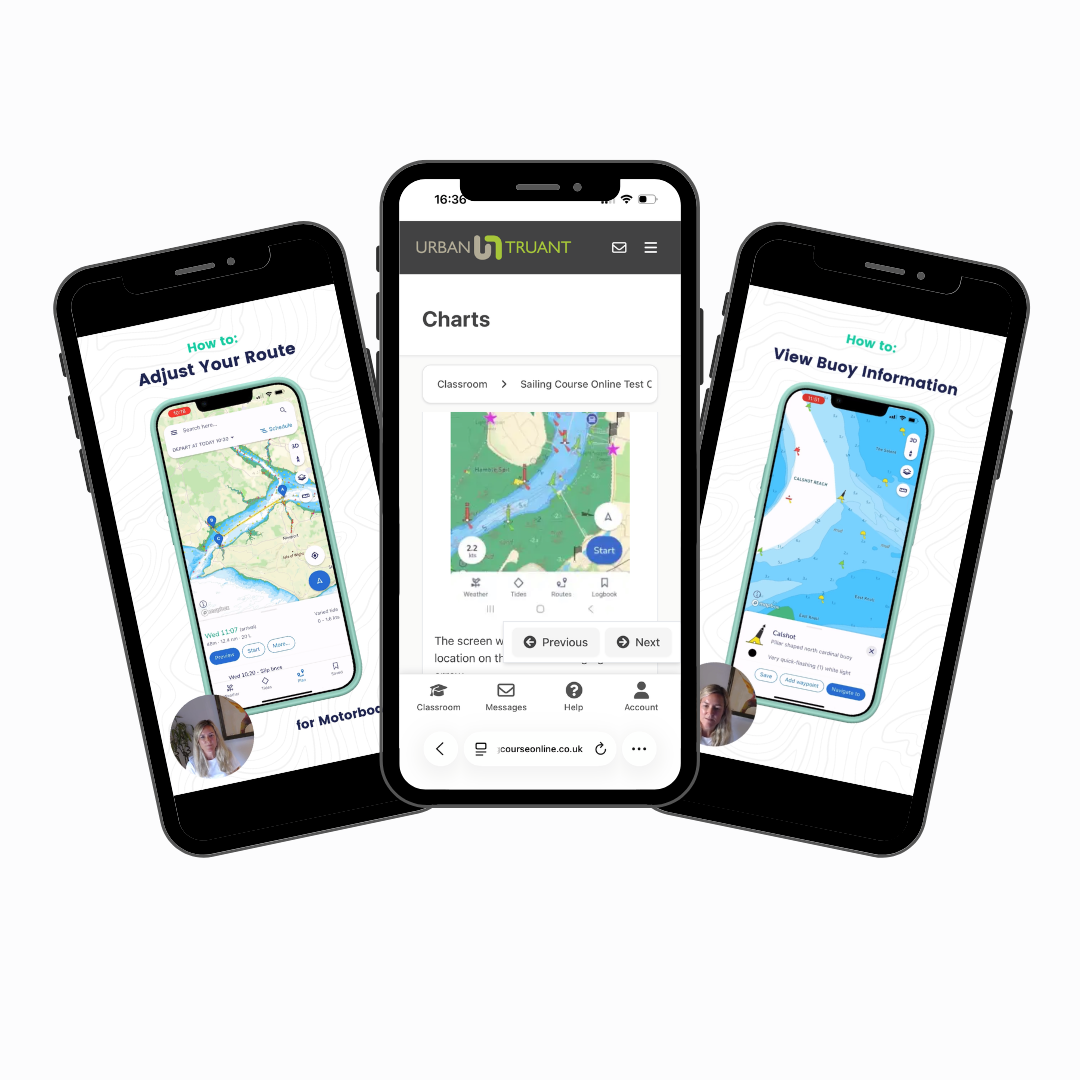
To help our students get hands-on experience with the kind of digital navigation tools the RYA Digital First syllabus covers, we have partnered with Savvy Navvy, the navigation app with over three million downloads globally.
Savvy Navvy calculates routes based on weather, tides, and your boat's specifications. It factors in tidal streams when suggesting departure times and routes, and recognises hazards like tidal races and traffic separation schemes. It is a good example of the kind of tool the Digital First approach encourages sailors to understand and use, while still knowing how to cross-check against traditional methods.
All students on our RYA Day Skipper theory course now receive a free 7-day trial of Savvy Navvy, plus 20% off a subscription.
How our theory course reflects the RYA Digital First framework
Our RYA Day Skipper theory course has been updated to reflect the 2026 RYA Digital First syllabus. We are proud of the fact that we can make these changes in real time because all content and our platform-based support are managed internally. As an RYA Practical Training Centre as well as an online provider, we can use our practical experience to make the online learning realistic and relevant.
If you are wondering what the Day Skipper qualification actually opens up for you, from bareboat charter to commercial endorsement, we have covered that in detail on the blog too.
The RYA has noted that over time, the requirements for approved electronic systems and charts will become clearer, allowing deeper simulator-specific and manufacturer-specific training for digital navigation on fully integrated systems. We will continue to update our courses as the framework develops.